Your Smart Lock Maker Shut Down. Five Checks Before You Call an Attorney
When a connected device stops working because the company behind it folded, the question is not whether you have a case but whether a lawyer is the tool that fixes it.
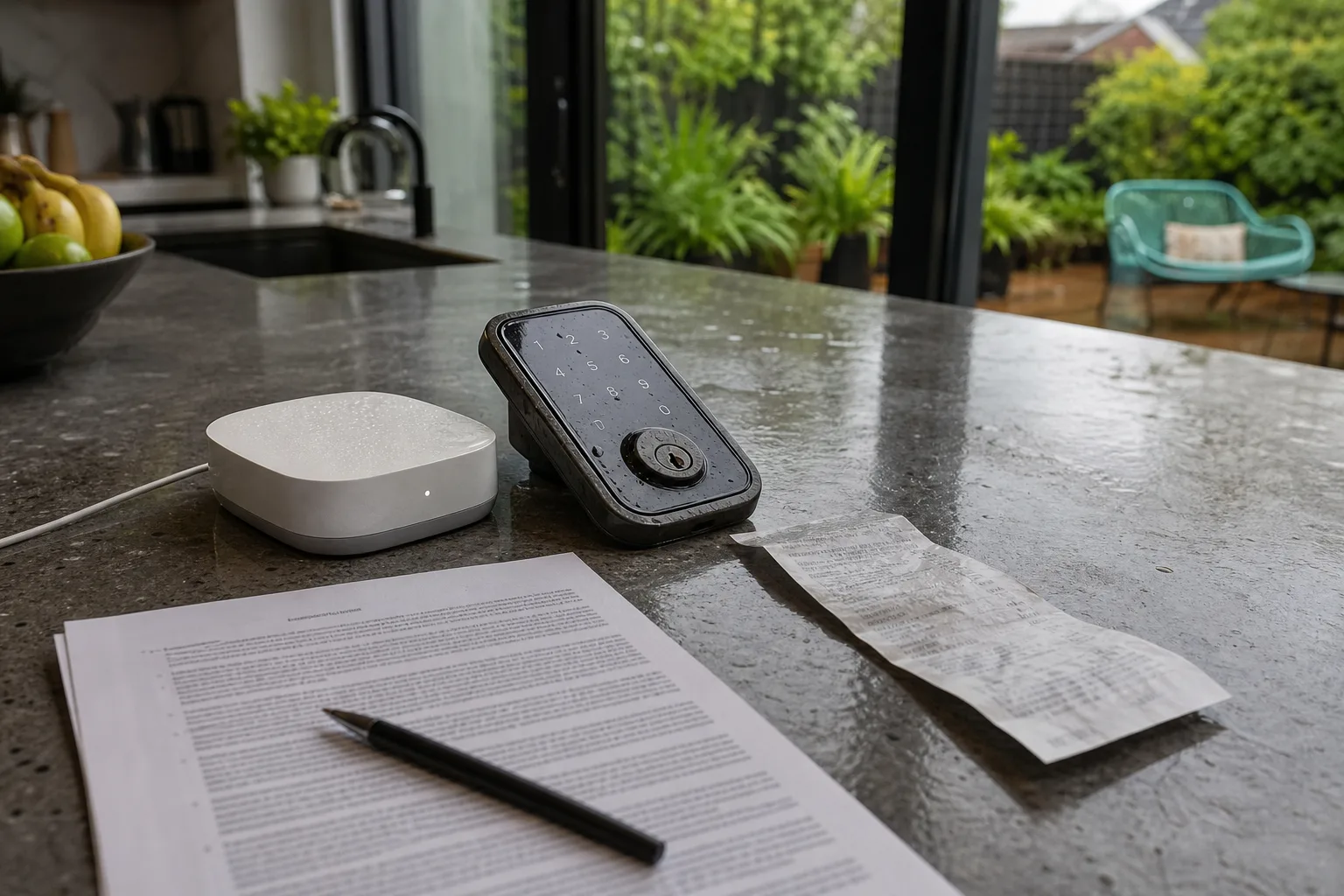
The assumption that costs households the most money is that an attorney is simply the next step up from a complaint, the thing you escalate to when the support line stops answering. In practice the decision runs on four or five narrow questions, and most of them have nothing to do with whether you were wronged. You can be plainly in the right and still have no sensible reason to hire counsel, and you can have a small, unglamorous problem that genuinely needs an hour of professional attention because a clock is running. Connected devices make this sharper than almost anything else in a house, because the thing you bought depends on a company that may no longer exist.
1. Find out who the counterparty actually is, and whether it still exists
A smart thermostat, a camera, a lock, a sleep tracker: each one is sold by a brand, manufactured by someone else, and kept alive by a cloud service that may be run by a third party under contract. When the service goes dark, the household's instinct is to name the brand on the faceplate. That entity may be a dissolved limited liability company with no assets, a subsidiary whose parent has already written it off, or a trade name assigned in a bankruptcy to a buyer who took the trademark and none of the obligations. A judgment against a company with nothing in it is a piece of paper. Before anything else, find the legal name on the receipt, the terms of service, and the warranty card, and search your state's business registry for its status.
2. Weigh the loss against the way legal work is actually priced
Consumer matters of this kind are almost never taken on contingency, because there is no large settlement to take a percentage of. You are looking at an hourly rate, or at a flat fee for a defined task such as a demand letter or a review of a contract. That changes the arithmetic completely. A four hundred dollar doorbell that stopped working is not an hourly-rate problem, and anyone who tells you otherwise is selling time rather than judgment. A three thousand dollar whole-house system, professionally installed, with an installer who is still in business and still accepting calls, is a different matter. Small claims court exists precisely for the middle of that range, and in most states you file it yourself.
3. Check whether a deadline is already running against you
This is the check that genuinely argues for picking up the phone, and it is the one households skip. Credit card chargeback rights run on a tight window measured from the transaction or the expected delivery, not from the day you noticed the problem. Manufacturer warranties expire. State consumer protection statutes carry limitation periods. Arbitration clauses frequently impose their own, shorter deadline for giving notice of a dispute, and an opt-out right that lapses thirty days after purchase. Class action settlements have claim deadlines that pass quietly. If any date in your situation is within a few months, the calculation changes, because the cost of a single consultation is small next to the cost of losing a remedy you already had.
4. See whether a regulator or an issuer will do the work for free
A great many device and service disputes sit squarely inside somebody's existing jurisdiction, and that somebody does not bill you. The Federal Trade Commission is responsible for unfair and deceptive practices in consumer markets, including how products and connected services are advertised and what buyers are told about support. State attorneys general run consumer protection divisions that accept complaints and, in some matters, mediate them. If the purchase was financed or the charge is disputed, the card issuer's own process is faster than any court and costs nothing to invoke. None of these guarantees an outcome. But a complaint filed and documented costs you an afternoon, builds a record with dates attached, and occasionally produces a refund that no letter from an attorney would have shaken loose faster.
5. Name the remedy you want, then ask whether anyone can order it
Households usually want the device to work again. That is the one thing no forum can deliver. A court cannot order a shut-down server back online, cannot compel a dissolved company to publish firmware, and cannot manufacture a replacement hub that nobody makes. What a court or an arbitrator can order is money: a refund, the cost of replacement, sometimes the cost of ripping out and reinstalling a system that was sold as permanent. Once you have written the remedy down as a dollar figure, the question of whether to hire counsel usually answers itself. If the figure is small and the company is gone, the honest answer is to replace the hardware with something that runs locally and move on.
What this looks like when the clauses are read closely
Two documents decide more than anything else in the file. The first is the terms of service, which almost certainly contains an arbitration clause and a waiver of class participation, meaning the fight does not happen in the court you were picturing. The second is the purchase agreement, if a contractor installed the system, because that is where you find who warranted what and for how long. Read both before you form a view. An attorney reading those two pages for a flat fee, with your dates and your receipt in hand, will tell you in one sitting whether the matter is live, and that is a different purchase from retaining someone to fight.
The folder that makes the hour worth paying for
Whatever you decide, build the record while it is still retrievable. Save the shutdown email with its headers intact, screenshot the support page before it comes down, export the order confirmation, photograph the installed hardware and the serial numbers, and write a plain chronology with dates. Companies winding down take their documentation offline quickly, and the evidence that proves what you were promised tends to disappear first. If you later decide the matter is worth an attorney's time, that folder is what turns a vague grievance into a question someone can answer in an hour. If you decide it is not, you still have what you need for a chargeback, a complaint, or a small claims filing.
The useful habit, for anything in a house that depends on a company staying in business, is to ask the counterparty question before you buy rather than after the service dies. Does it keep working without the cloud. Who is on the receipt. What does the warranty say when the support site is gone. Those answers are cheap to get in advance and expensive to reconstruct later, and they are what determine, months or years on, whether you have a problem worth a lawyer or simply a device worth replacing.