Booking a Trip for Someone Else? The Party Whose Fees Never Show in the Listing
The nightly rate comes from one party, but the final bill is assembled by four, and the one nobody reads about is usually the one holding the keys.
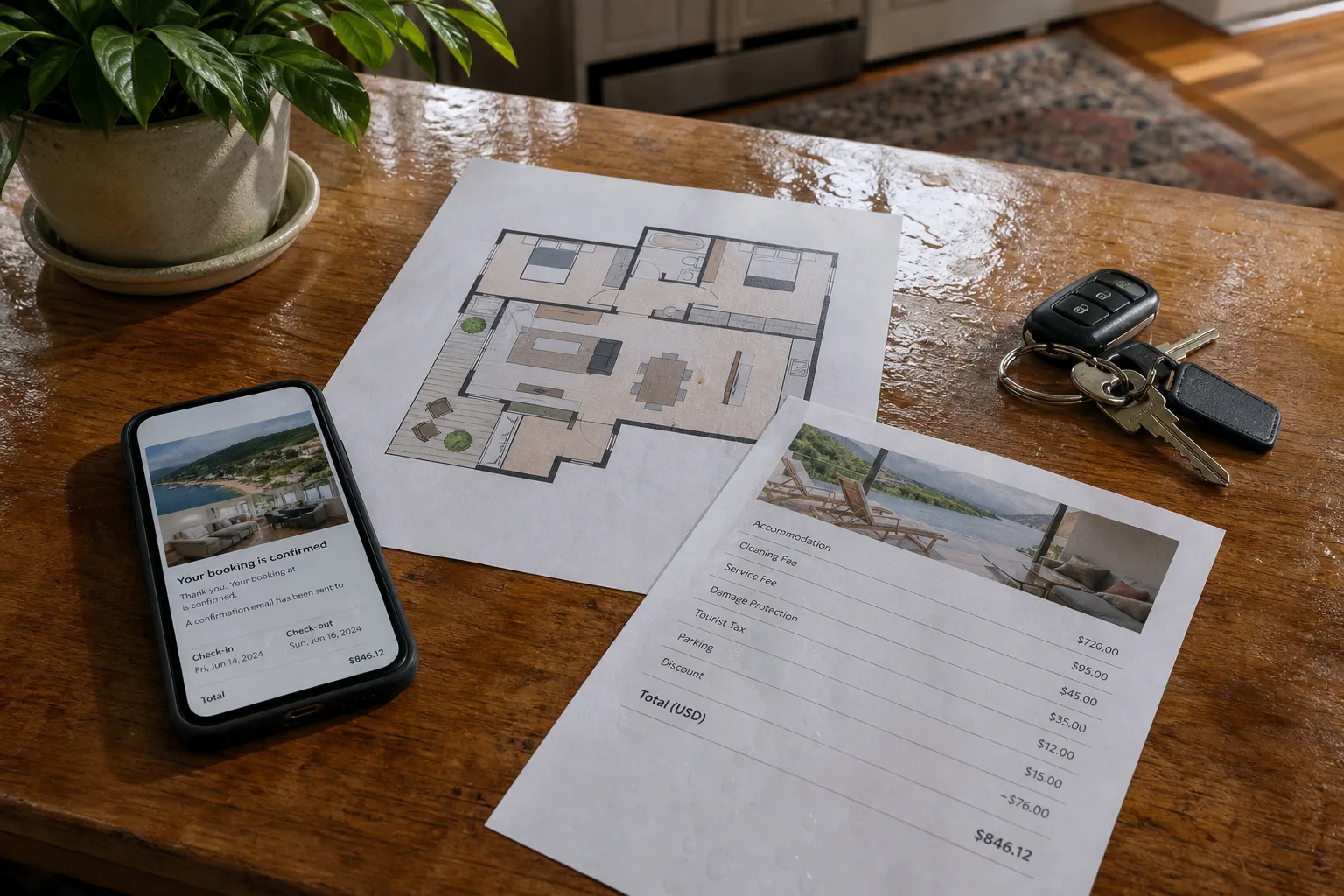
The number in the search results is produced by whoever controls the listing, and that party is frequently not the one who will hand over the keys, count the guests, or decide whether a folding bed costs anything. People booking for themselves absorb the difference and grumble. People booking on behalf of others, a parent's anniversary week, a sibling's family of six, a group trip where everyone pays a share, cannot absorb it quietly, because they have to explain it later. The gap between the advertised rate and the amount that leaves the account is not random. It is assembled by parties who each have a defined role.
The assumption is that one company sets the price
Most travelers treat the headline rate as a single company's asking price and everything after it as that company's upcharges, the way a store adds sales tax at the register. What actually happens is that four parties contribute to the final figure: the platform or agency that displays the listing, the property or operator that owns the inventory, the local government that levies occupancy and tourism taxes, and the payment processor that converts the currency and holds the deposit. Each one adds under different rules, at different moments, with different appeal routes. Only one of them has anything to gain from making the first number look small.
The party most people overlook is the second one, the local operator. On a large platform, the property manager is often invisible until the reservation confirms, appearing then as a name and a phone number in a message thread. That manager sets the cleaning fee, the extra-guest threshold, the parking arrangement, the pet policy, the damage deposit, and the late-checkout charge. They also decide, in practice, whether any of those are enforced. The platform displays their terms but rarely originates them, which matters enormously when you want something changed.
Booked direct or booked through a platform, and who can waive what
Booking direct usually puts you in contact with the party who can actually make decisions, which is worth more than a small discount. A manager who answers the phone can confirm that the third bedroom is a real room rather than an alcove, can tell you whether the extra-guest fee applies to a toddler, and can agree in an email to waive a late checkout on a departure day when nothing is arriving behind you. That email is enforceable in a way that a platform's generic policy page is not. The trade is that you lose the platform's dispute process, its payment protection, and its standardized cancellation terms.
Booking through a platform inverts the arrangement. You gain a written cancellation policy, a record of every message, and a company with a refund mechanism, but you are negotiating with someone who can only apply the property's stated rules. Support agents will tell you, politely, that the cleaning fee is set by the host. That is accurate. The useful move is to use the platform's messaging to ask the property direct questions before you book, because those answers are timestamped, attached to the reservation, and readable by a support agent later if the two accounts diverge.
Several of the fees are generated by the floor plan
A surprising share of post-booking charges are not fees at all in any commercial sense. They are consequences of how the space is arranged and how many bodies it is rated to hold. A listing that sleeps six may reach that number with a sofa bed in the living room, and the sixth person triggers an extra-guest charge, a linen charge, and sometimes a higher cleaning tier because a second bathroom comes into use. The plan drawing, if one is published, will show you this before the invoice does. Count doors, not headcounts.
Parking works the same way. An apartment with one deeded space in a building of thirty will quote parking as an extra because the manager has to buy the second space from a neighbor or a nearby garage. A property with a driveway will not mention parking at all. When you are booking for a group arriving in two or three cars, the question to ask is how many vehicles the property can hold on its own land, and what the arrangement is for the rest. A few feet of driveway decide whether that line exists.
The taxes come from a party that is not selling you anything
Occupancy taxes, tourism assessments, and district levies are set by the city or county, not by the host or the platform, and they cannot be waived by either. They vary by jurisdiction and sometimes by length of stay, with many places exempting stays beyond a monthly threshold. Resort fees and destination fees are a separate matter: those are charged by the property, and how they must be disclosed in an advertised price falls within the Federal Trade Commission's remit over how prices are presented to consumers. The distinction is practical. One is negotiable at the front desk. The other never is.
The fourth party, the payment processor, usually shows up twice. Once when a card terminal abroad offers to bill you in dollars at its own conversion rate, and once when a damage deposit is authorized against the card and sits there for a week or two after checkout. Neither is a surprise if you expect them. Decline the dollar conversion, use a card with no foreign transaction fee, and confirm in writing when the deposit hold is released, particularly when the card belongs to someone who is not traveling.
What to confirm before the money moves
Ask the operator, in writing and before payment, for the all-in total for your exact party size and dates, itemized. Ask what the deposit is, how it is taken, and when it comes back. Ask how many vehicles fit. Then forward that message to whoever is traveling, because the person who agreed to the terms and the person standing at the door at four in the afternoon are rarely the same, and the written total is what settles any disagreement between them.
The headline rate is a real number. It is just the first of four, and the second one answers the phone.