Booking the Trip for Everyone Else? The Costs That Land After the Headline Price
The second bill on a family trip comes from floor area, walking distance and the ordinary week, and you can price most of it before anyone agrees to pay.
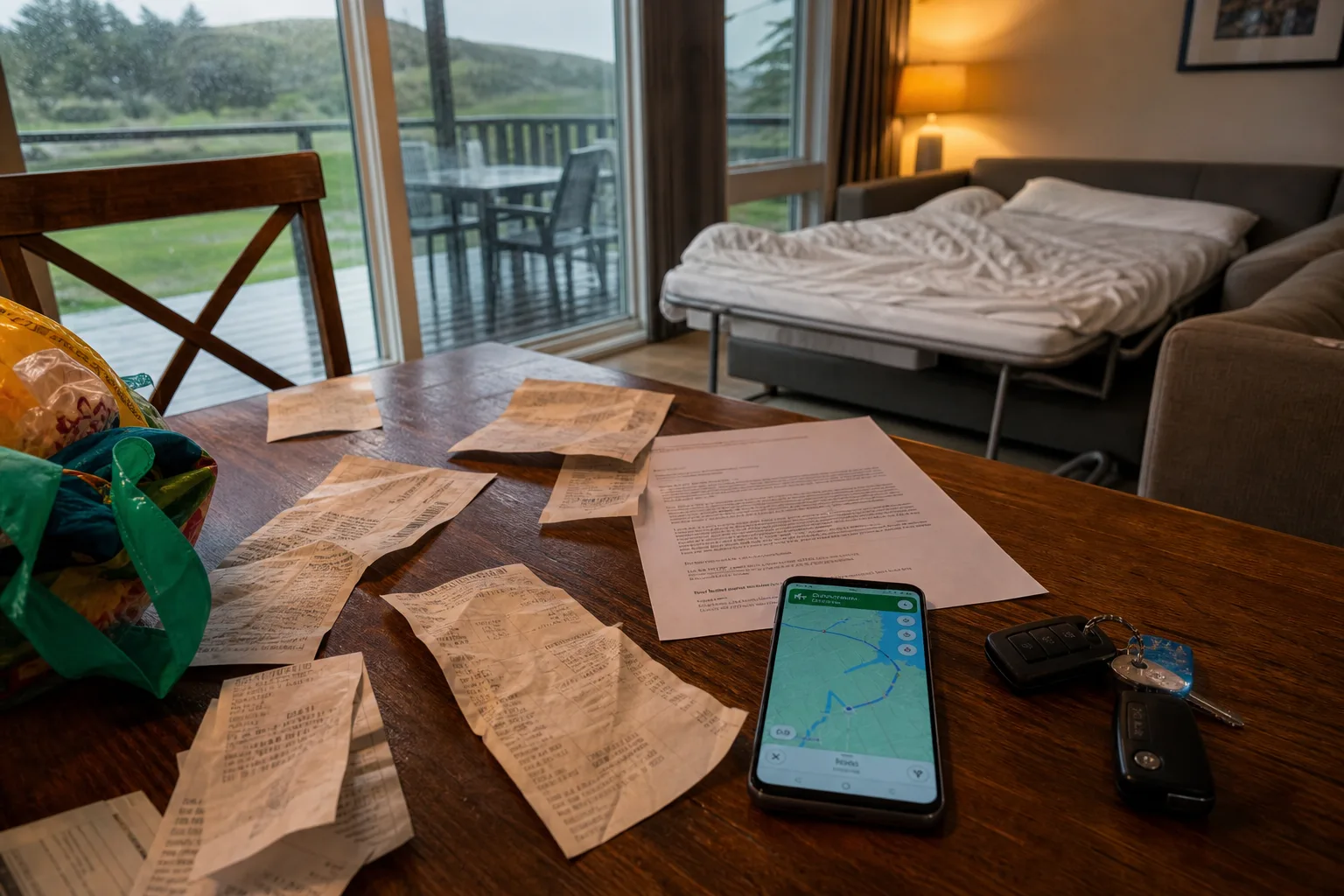
The number you remember from a booking page is almost never the number that leaves your account. That gap is not usually a scam, and it is rarely hidden in a single line of fine print. It accumulates, quietly, from decisions about space and distance that were made before you ever saw the listing: how many square feet the unit has, how far the parking is from the door, whether the kitchen has an oven or a two-burner cooktop. If you are the one booking on behalf of four or six other people, that gap becomes something you will have to explain later.
The plan drawing hides the third person
A rental listing gives you a headline capacity and a set of photographs taken from the one corner of the room where the lens flatters it. What it rarely gives you is the dimension that decides the trip: the clear floor area once the beds are open. A room advertised as sleeping four often sleeps two comfortably and two on a convertible sofa that, unfolded, blocks the bathroom door. The consequence is not discomfort in the abstract. It is a second room booked on night three, at walk-up rates, because two adults are not sleeping. That is a layout problem that arrived as a cost.
So read for dimensions rather than adjectives. Bedroom counts tell you less than a floor plan, and a floor plan tells you less than the distance between the sink and the nearest table. Where measurements are not published, ask the host directly and keep the answer in writing, because a few feet of circulation space around a crib or a walker decides whether one unit works for the group you actually have. If you are booking for a parent with limited mobility, stair counts, threshold heights and the width of a bathroom doorway are the numbers that matter, and they are the ones almost never listed.
Price the ordinary week, not the trip
Most post-booking spending is not exotic. It is groceries, laundry, coffee, sunscreen, one pharmacy run, parking, and the transit or rideshare that closes the last mile between where you are staying and where you intended to be. None of it feels like a travel expense while it is happening. All of it lands on the same statement. The useful exercise is to take your ordinary household week, the one you already know the cost of, and ask which lines go up when you are away from your own kitchen, your own washing machine and your own car.
Done honestly, this reorders your choices. A unit with a working oven, a dishwasher and a laundry closet can absorb a higher nightly rate and still come out cheaper across six days, because it takes eight or ten restaurant meals out of the week. A unit a mile from the beach with free parking may beat one across the street from it that charges nightly for a space and sits where every errand becomes a paid ride. The comparison you want is not rate against rate. It is total against total, divided by nights, with the ordinary week included.
The fees that attach to the booking itself
Separately from your own spending, there is a category of charge that belongs to the vendor and appears late in the flow or on arrival. Resort and destination fees, cleaning and pet fees, service charges, parking, early check-in, baggage and seat selection, airport facility charges, and the assortment of rental car items that are quoted as daily rather than total. The Federal Trade Commission is the agency responsible for how prices and fees are disclosed to consumers, and disclosure practices in travel have been moving toward showing totals up front. Until that is uniform, you have to force the total yourself.
The practical method is to carry every option to the final confirmation screen before you compare anything, because that is the first place the whole number appears. Screenshot it. Note which items are per night, per person and per stay, since a per-person fee is what turns a reasonable quote for two into an unreasonable one for five. On rental cars, ask specifically about the second driver, the fuel policy and the young or senior driver surcharge, and on flights, price the bags for the group rather than for yourself, because a family of four checking one bag each is a meaningful fraction of a fare.
What has to be agreed before anyone pays you back
Booking for a group makes you a lender, and the terms of that loan are usually never stated. The trouble comes later, when you send a total and discover that two people assumed groceries were shared, one assumed the rental car was included in the nightly split, and one has quietly been paying for dinners and expects that to count. None of these people are behaving badly. They simply held different pictures of the same arrangement. The cure is a short written note, sent before deposits go out, listing what is in the shared pot and what each household covers on its own.
Say it plainly: the lodging and the cleaning fee split evenly by household, the car and gas split evenly, groceries in the shared pot with receipts kept, restaurant meals paid by whoever eats them, and one named person holding the ledger. Say what happens if someone cancels, since the deposit is usually nonrefundable and someone will otherwise absorb it alone. If you are booking for an older relative who is not paying but has strong preferences, the conversation is different and still worth having, because the person who will live in the room for six days should know the stair count and the bathroom layout before the money moves.
Building the judgment so next year is quicker
Judgment here is not instinct. It is a record. After each trip, while the statement is still fresh, write down three numbers: what you expected to spend, what you actually spent, and where the difference came from. Two or three trips of that and you will know your own household's pattern with some precision. Perhaps your gap is always food, because nobody cooks on vacation regardless of the kitchen. Perhaps it is always transportation, because you consistently underestimate distance on a map. The gap is stable per household in a way that no general advice can tell you in advance.
That record also changes how you read a listing. Once you know that a poorly laid out unit costs you roughly one extra restaurant meal a day, you stop treating floor plans as a comfort question and start treating them as a budget line. Once you know how far you will genuinely walk with a tired child or a parent who tires quickly, the distance figure on the map becomes a rideshare estimate rather than a detail. This is the point at which a headline price starts to be useful to you: not as the cost, but as one input among several you now know how to weigh.
Book the option you can describe fully to the people traveling with you, in dimensions and dollars, before anyone sends a dime. If you cannot say how far the parking is, what the sofa bed does to the living room, or which fees are per person, you do not yet have enough to decide, and the questions that get you there take one message to a host and ten minutes with a confirmation screen.