Boxed-In Appliances and a Stairwell Ceiling. What Actually Decides Which Chores You Hire Out
The upkeep jobs households pay for are rarely the hard ones. They are the ones the floor plan made unreachable, and the pattern is visible before you move in.
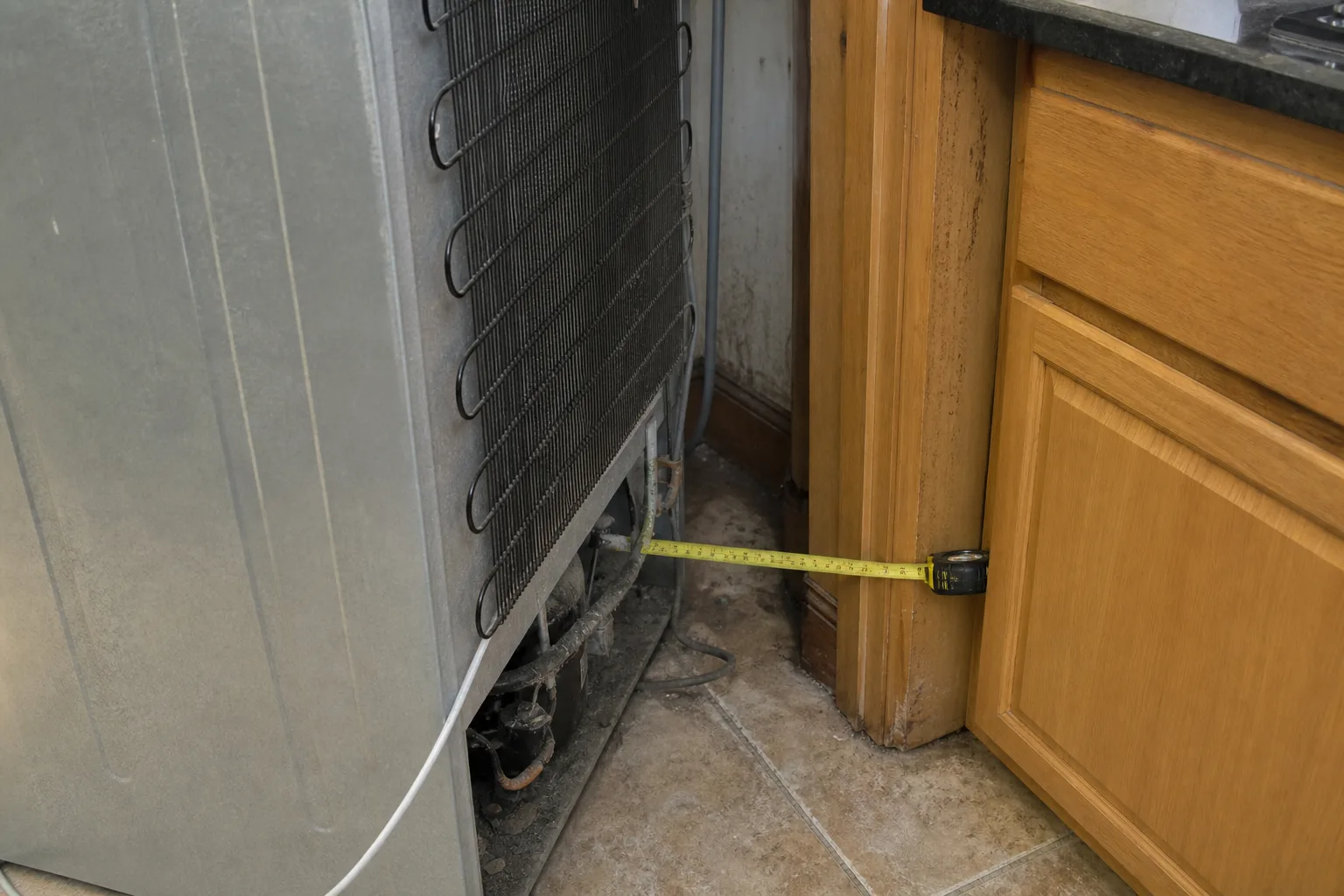
Walk through enough houses with a tape measure and the same jobs keep showing up on the hire-it-out list, in kitchens of every budget and every decade. Not the difficult jobs. The unreachable ones. A refrigerator set into a cabinet run with three quarters of an inch on either side cannot be pulled forward by one person without scarring the flooring, so the condenser coils behind it are cleaned when someone is paid to clean them and not otherwise. The skill involved is negligible. The clearance is the whole story, and it was decided on a plan drawing years before anybody lived there.
That is the pattern worth understanding before you build a maintenance budget, because it tells you which line items are permanent and which are a phase. A household that assumes it is paying for expertise will keep hoping to learn the job and stop paying. A household that understands it is paying for access, for a second set of hands, for a ladder that will not fit up its own stairs, will price the work correctly and stop feeling defeated by it.
Clearance, reach and pull-out distance are the three measurements that decide
Three dimensions predict almost every recurring upkeep expense in a house. The first is side clearance: whether an appliance can be walked out of its opening without lifting. The second is reach: the vertical distance from a stable standing surface to whatever needs attention, filters, vents, light diffusers, the tops of tall windows. The third is pull-out distance, the depth of clear floor in front of a thing once it has been moved. A washer needs roughly its own depth again to be serviced comfortably, and a laundry closet with bifold doors and a hallway behind it rarely offers that.
Once you start reading rooms this way, the household's grumbles resolve into geometry. The dryer that takes two cycles is not a failing machine so often as a vent run that turns twice and has never been opened, because opening it means pulling a machine that sits between a wall and a door swing. The bathroom fan that no longer clears steam is usually clogged rather than dead, and the reason it is clogged is that the ceiling it sits in is over a tub, where no ordinary stepladder can stand square. The consequences arrive as symptoms and get traced back to the wrong cause.
The consequences nobody traces back to a floor plan
Ask a household why the grout in one shower has gone dark and the identical shower upstairs has not, and the answer is often that one has a fixed glass panel eighteen inches from the wall, making the far corner a two-handed job with no room for two hands. Ask why the return air filter was changed twice in six years, and the answer is that it sits in a ceiling grille above a stair landing, where the ladder cannot be footed level. Ask why the gutter on the north elevation overflows every fall, and the answer is a bay window that pushes any ladder out beyond a safe angle.
None of those households were careless. Each of them had one detail of the building that priced a fifteen-minute task out of reach, and the cost surfaced somewhere else entirely: a higher electric bill, a stained ceiling, a fascia board that needed replacing at a hundred times the price of the cleaning that would have saved it. The useful move is to identify those details deliberately rather than discovering them through damage, then to accept them as a standing line in the budget and buy them properly.
Height and footing are where paying somebody stops being optional
The judgment gets simpler above a certain height. The Occupational Safety and Health Administration is responsible for the rules that govern ladder use and fall protection on job sites, and while none of that binds a homeowner on a Saturday, the reason those rules exist is that the injuries are severe and the mechanism is dull. A ladder footed on gravel, on a slope, on a deck board that flexes, or angled wrong because a bay window is in the way. Two-story gutters, roof-mounted anything, and stairwell ceilings belong to a paid crew with staging, and the price you are paying is for the equipment and the second person on the ground.
Inside the house, the equivalent threshold is weight combined with connection. Anything that has to be disconnected before it can be moved, gas, water supply, a rigid vent, is worth handing over, not because reconnecting is hard but because a supply line that has been flexed at fourteen years old sometimes does not seal again. The whole benefit of the cleaning is erased by one slow drip behind a machine that nobody will look at again for a year.
Write the scope in terms of movement, not tasks
When you hire this work, the specification that produces a fair price and a real result describes movement. Pull the range forward and clean behind and beneath it, reseat it, and confirm the anti-tip bracket engages. Remove the dryer, disconnect the transition duct, clear the full run to the exterior hood, and reconnect with a clamp rather than tape. Open the bathroom fan housing, wash the blade wheel, verify the damper opens. Written that way, three contractors are quoting the same job, and the one who has allowed for moving a machine out of a tight closet is not undercut by the one who planned to vacuum the front of it.
It is also worth asking for photographs of what was found, taken before and after, especially for anything above head height or behind an appliance. That is the record you use next year to decide whether the interval was right, and it is the record an insurance adjuster or a buyer's inspector will accept as evidence that a system was maintained rather than merely paid for.
The renovation moment is when this gets cheaper for good
Every one of these costs is negotiable exactly once, at the point when a wall is open or a layout is being drawn. An extra inch and a half of side clearance beside a refrigerator, an access panel in the closet wall behind a shower valve, a fan placed over the floor rather than over the tub, a laundry closet door that swings out rather than folding in: each of these changes nothing about how the room looks and permanently changes what the household can do without hiring anyone. Cabinet makers and architects will accommodate the request if it is made early, and it costs nothing at that stage.
What survives that exercise, the second-story gutters, the tall stairwell, the chimney, is the honest list. Price it annually, book it in the same month each year, and treat it as a fixed cost of the building rather than a personal failing.