Escalating for Someone Else? How to Tell Which Rung Can Actually Say Yes
Most complaints stall because they are addressed to someone with no authority to grant them. Here is how experienced complainants read the ladder before they climb it.
The first person who answers is almost never the person who can decide. That single fact governs the order of everything that follows, and people who have run a lot of complaints treat it as the opening measurement, the way you check a doorway before you buy the sofa. The agent on the phone can log, apologize, resend, and occasionally waive something small. They cannot rewrite a denial, authorize an exception, or overturn a policy decision made three levels above them. Escalation is not persistence. It is the process of getting your request in front of the one person whose job description contains the word yes.
Map the authority before you write a word
A complaint has a floor plan, and the published one is rarely the real one. The website shows a general inbox, a phone tree, and perhaps a form. What it hides is the internal structure: a frontline queue, a supervisory tier that can approve a credit up to some threshold, a resolutions or executive relations desk that handles anything with a regulator's name attached, and a legal or compliance function that only wakes up for certain triggers. Before drafting, ask the person you reach a plain question. What is the limit of what you personally can approve, and who reviews it if you cannot.
Most representatives answer that honestly, because it moves the call off their desk. The answer gives you the next rung by name and function, which is worth more than a manager's first name. It also tells you when to stop. If the request sits inside that person's authority, escalating is a mistake: you restart the clock, lose the goodwill of someone already engaged, and hand the file to a stranger with no history of the conversation. Judgment here is mostly restraint. Climb only when the ceiling is genuinely lower than the ask.
Each round buys evidence, not just an answer
Someone who has done this many times writes the first letter knowing it will probably be refused, and writes it for the reader two steps later. That changes the drafting. You state the facts in dated order, you name the specific term or promise you are relying on, you say exactly what outcome you want in dollars or in actions, and you stop. No adjectives, no history of how the whole company has treated you, no threats you have not decided to carry out. A refusal to a clean request is useful. A refusal to a sprawling one tells you nothing about which part failed.
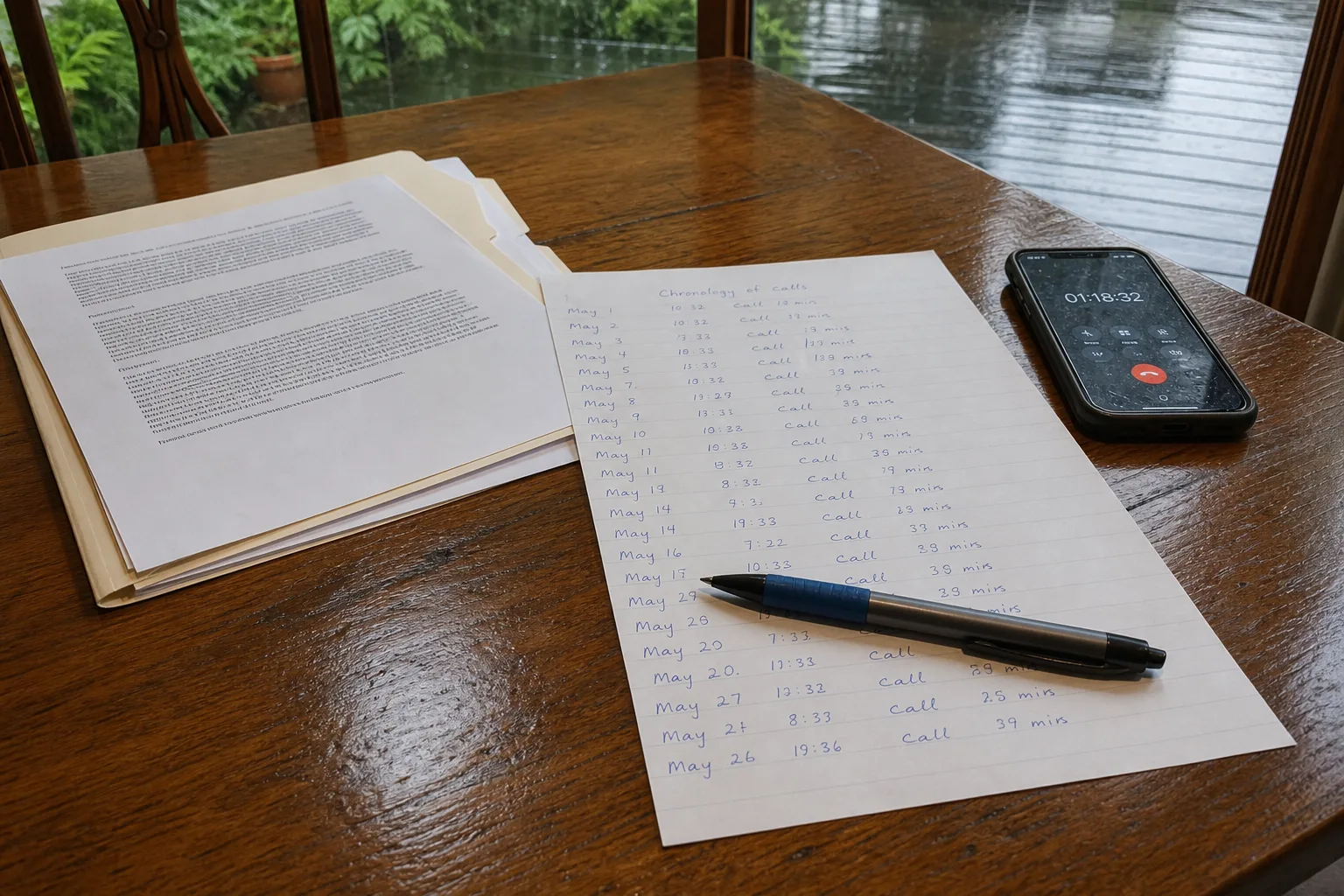
Keep the chronology on one page and add to it after every contact: date, channel, name, what was said, what was promised, what arrived. Save the confirmation emails, the reference numbers, the screenshot of the chat before the window closes. When the file eventually reaches a resolutions desk, a state agency, or an attorney doing an hour of paid review, that page is what gets read first, and it is what distinguishes a complaint that can be assessed in ten minutes from one that gets set aside. Precision at the start is what makes the later steps cheap.
Reading the pause, and finding the clock that binds
The hardest part is timing, because the visible delay and the real deadline belong to different calendars. Companies often have an internal service standard: a set number of business days to acknowledge, another to substantively respond. Outside that, the deadlines that actually constrain you are elsewhere, in a policy's proof-of-loss window, a warranty period, a card network's chargeback limit, a statute of limitations, or the filing period at whichever body oversees the sector. The Consumer Financial Protection Bureau, for example, is responsible for receiving and routing consumer complaints about financial companies, and its process runs in parallel with, not after, whatever the company is doing.
So the experienced move is to find the binding date first and work backward, leaving room for one internal round and one external filing. Give a step the time it was promised plus a short margin, then move without drama. A follow-up that says the response date has passed and the file is going to the next tier on a stated day is more effective than four angry messages, because it is verifiable. Silence is information. Read it as a decision to do nothing, and act accordingly rather than waiting for permission to be dissatisfied.
When the decision is not yours to live with
Escalating for a parent, a tenant, an aging client, or an adult child adds a step most people skip. You are choosing on behalf of someone who will carry the outcome: the continued relationship with the landlord, the insurer, the care facility, the utility. Before the second letter goes out, agree on three things and write them down. What result would count as acceptable, so you can stop rather than chase a principle. What you are willing to spend, in money and in their time. And what you will not do, whether that is a lawsuit, a public review, or a call to a regulator that they may not want made in their name.
Then get the authority in order. Many organizations will not discuss an account with a relative absent written permission, a recorded authorization on file, or a power of attorney, and discovering that on the escalation call wastes the call. Ask early what form the consent must take. Confirm afterward, in writing, what you did and what was said, so the person you are acting for has the record and is never surprised by a letter arriving at their address. That habit does more than protect them. It keeps you honest about whose complaint this is.
The judgment compounds
What separates the tenth complaint from the first is not a better script. It is knowing, within a few minutes of the first contact, whether the matter can be settled at that level, what the next level is called, which clock is really running, and what the person you represent actually wants from it. Those four readings are learnable, and they are portable across insurers, contractors, schools, hospitals, and government offices, because the structure repeats. A few centimeters of preparation at the start decide whether the whole thing fits.
Keep the one-page chronology even after the matter closes. The next dispute, for the same person or a different one, starts from a template you have already tested, and the second run is always shorter than the first.