First Time Sending a Ring Out for Repair? Who Is Actually Holding It, and Why the Advice Splits
Two shops, two opposite answers on the same ring. The disagreement usually comes down to construction, millimeters of metal, and which bench the work reaches.
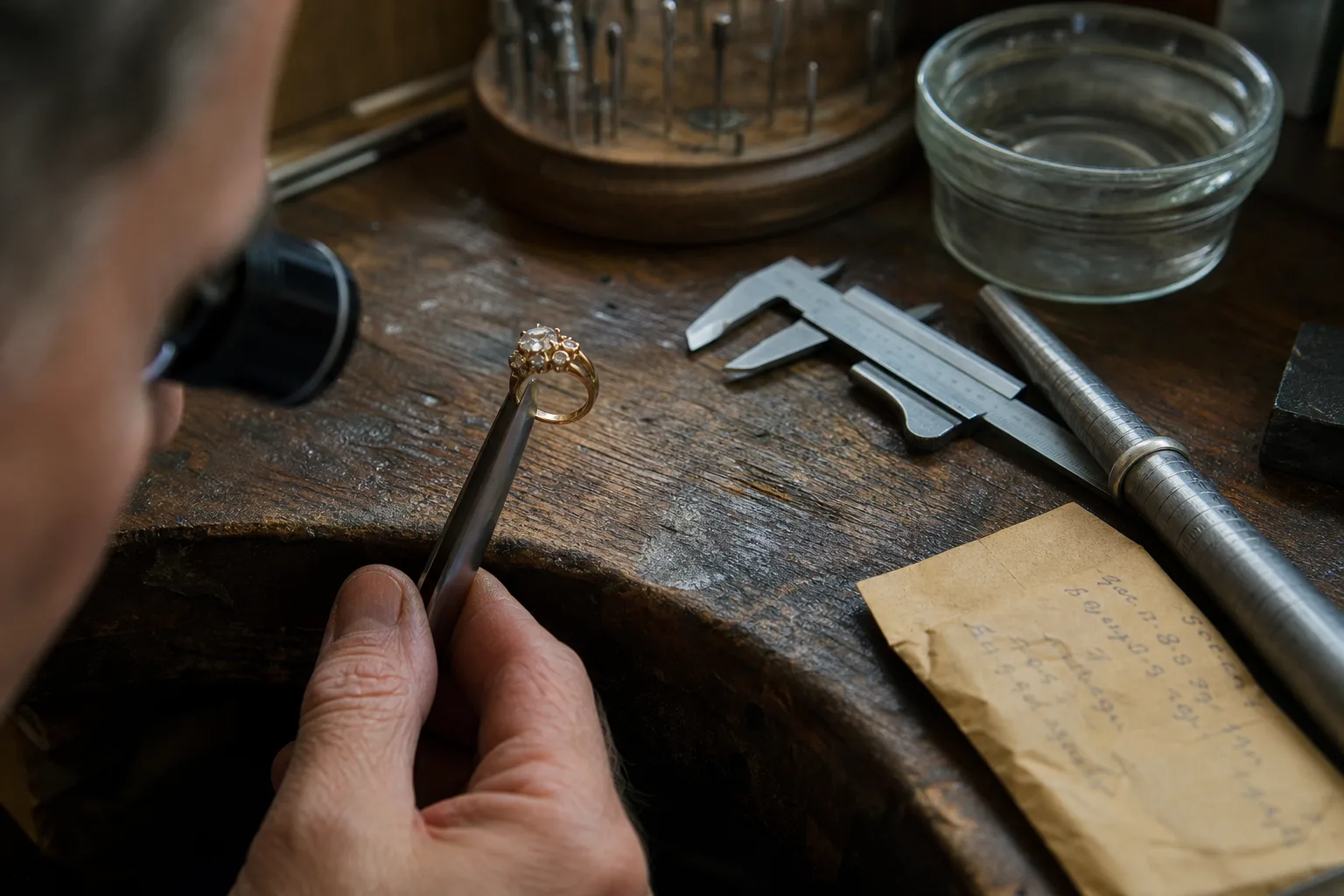
A ring is a small piece of engineering with very little tolerance in it. The shank on a well-worn band may be under a millimeter thick at the bottom, the seat that holds a stone may sit two tenths of a millimeter deeper than it should, and a size change of one and a half means moving roughly four millimeters of circumference. That is the whole argument. When one shop says a ring can be sized and another says it cannot, they are rarely disagreeing about principle. They are reading different amounts of metal, and often only one of them has put the piece on a scale and under a loupe.
The person at the counter is usually not the person at the bench
Most retail jewelry stores do not repair anything on the premises. The person who takes the ring, writes the envelope and quotes a price is a salesperson, and the work travels to a trade shop that may be in another state, batched with several hundred other envelopes. That arrangement is normal and often produces good work, but it explains why the first answer you get can be confident and wrong. The counter has a price list organized by task. The bench has the ring in a pair of tweezers. When those two disagree, the ring comes back with a phone call attached, and the revised number is the real one.
A first-timer can close most of that gap with one question at drop-off: does a bench jeweler look at this before the price is fixed, and can I have that person's assessment in writing before work starts. Independent shops with a jeweler on site will often bring the piece back to the bench while you wait. That five-minute inspection is where the conflicting advice usually resolves, because someone finally measured something.
Why the sizing answer depends on how the ring was built
Sizing sounds like one operation and is really four or five, chosen by construction. A plain band is cut, spread or shortened, soldered and finished. A ring with stones set all the way around, an eternity band or a channel of small diamonds running past the halfway mark, has no plain metal to cut, and making it larger stretches the seats holding the stones out of true. Some can be rebuilt at real cost. Some genuinely cannot, and the honest answer is that the piece is remade rather than sized. Tension settings, where the stone is held by the spring of the metal itself, lose their grip if the shank is altered at all.
Then there is direction. Going down is easier than going up, because metal is removed rather than added and the profile stays consistent. Going up more than one or two sizes on a thin shank thins it further, and a competent jeweler will propose adding new metal, a shank replacement or a half-shank, instead of stretching what is left. Sizing beads or a spring insert solve a different problem entirely: a ring that passes a large knuckle but then spins on a narrower finger. That is a fit problem, not a size problem, and the two get confused constantly.
The appraiser and the insurer are standing behind this decision
An independent appraiser, ideally one with a gemological credential and no interest in selling you a replacement, works from measurements, weight and photographs. Repairs change all three. Retipping worn prongs adds metal, recutting a chipped stone removes weight, and replacing a shank alters the piece enough that an old appraisal no longer describes what you own. If the item is scheduled on a homeowners policy or a standalone jewelry floater, tell the carrier before the work, not after a loss, and ask whether an updated valuation is required. The Federal Trade Commission oversees how jewelry is described and disclosed in the trade, which is why a written work order naming metals, karat, stone counts and treatments matters more than a verbal summary.
Photograph the piece yourself before it leaves your hands, including the underside of the head and the inside of the shank where hallmarks sit. Ask for the stone weights and dimensions on the ticket. If a stone is removed during work, ask when it is coming out and when it goes back.
What is worth fixing, in the order it becomes urgent
Loose stones and worn prongs come first, because the cost of ignoring them is the stone. A prong that has thinned to a sliver is cheap to retip and expensive to mourn. A shank worn to a knife edge will crack, usually at the bottom, and a new half-shank is routine work. Scratches, a slightly bent head and dull finish are cosmetic and can wait for the same visit. A chipped or abraded stone is the genuine judgment call, since recutting means weight loss and a new outline, and the sensible sequence is an appraiser's opinion before a cutter's quote.
Get two assessments if the first one surprises you, and make sure the second one comes from someone who has held the piece rather than a description of it. The disagreement almost always turns out to be about millimeters, and millimeters can be measured.