Five Crews Will Walk Through the House by Tuesday. What Each One Owes You in Writing
In the first forty-eight hours after water damage, five separate trades pass through the house, and each one leaves behind a record you have to ask for by name.
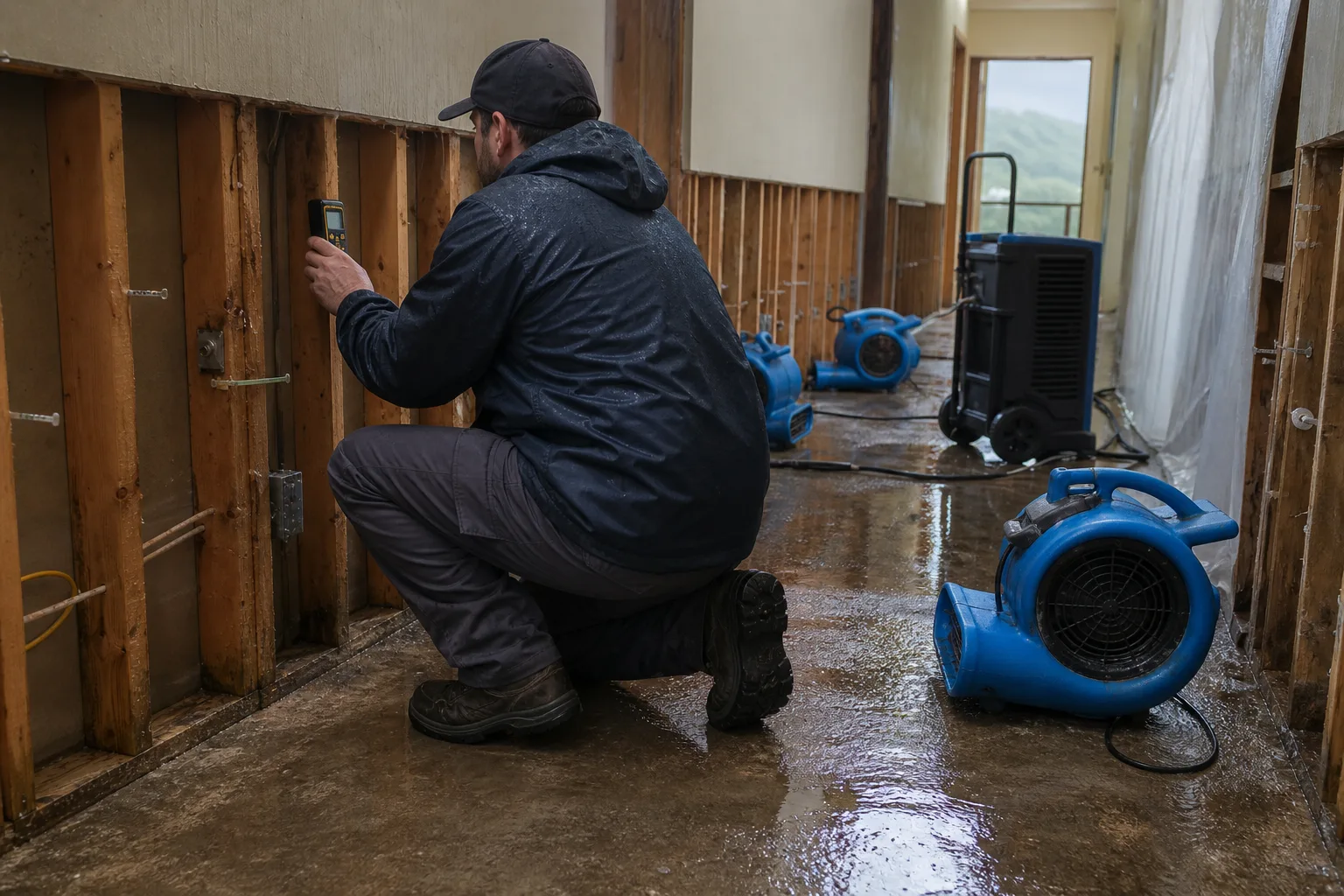
The first van to reach a wet house is almost never the one that decides anything. It belongs to the mitigation crew, three technicians and a truck full of air movers, and their job is to stop the loss from growing while everyone else catches up. The plumber may come later, the adjuster later still, and the person who writes the repair estimate might not set foot in the building for a week. If you are handling this for someone else, a parent in a hospital bed, a tenant, an estate you are administering, the sequence matters more than any single conversation in it.
The order they arrive in, and who can stop the next one
A crew that has done this several hundred times works to a rough script. Someone kills the water and the power to affected circuits, someone extracts standing water, someone maps how far the moisture traveled, and only then does anyone talk about what gets replaced. The technician on site has authority over drying and almost nothing else. He can tear out a baseboard to open a wall cavity, and he can tell you the carpet pad is gone, but he cannot commit an insurance carrier to paying for a kitchen. Ask each person plainly which decisions sit with them, because the honest answer is usually narrower than you expect.
That narrowness is useful. When you know the mitigation lead controls the drying plan and the estimator controls the scope of repair, you stop asking the wrong person for permission and stop treating a sympathetic remark as a commitment. It also tells you where to slow things down. Demolition beyond what drying requires is the one step in the first two days that is genuinely hard to reverse, and a seasoned technician will tell you so without being pushed, because he has watched homeowners regret cabinets that came out on day one for no documented reason.
The readings are a document, not a comment in passing
Moisture work has quietly become an instrumented trade. The technician carries a pin meter and a non-invasive meter, probably a thermal camera, and the dehumidifiers and air movers on your floor may report their own temperature, humidity and runtime to a platform his employer subscribes to. Those daily logs are the evidence that the structure dried, how long it took, and which rooms were actually affected. They are the difference between a settled claim and an argument six weeks later about whether a wall was ever wet. Nobody hands them over unprompted, because to the crew they are routine.
So ask for them in a form that survives the vendor. A PDF of the daily moisture log emailed to you, the initial mapping sketch, and the photographs taken before any material came out, all sitting in your own email rather than behind a login on a portal you do not control. Restoration companies merge, get bought, and occasionally close, and monitoring platforms are retired with them. A cloud record you can only reach through somebody else's account is not a record you have. Two minutes of asking on day two saves a reconstruction of events later.
Authorization to mitigate is not approval of the repair
The paperwork the crew presents in the first hour is a work authorization and, often, a direction to pay that assigns part of the insurance proceeds to them. It covers emergency services: extraction, drying, antimicrobial application, limited removal of unsalvageable material. It says nothing about the floor, the drywall or the cabinets. A second and separate document, produced by an estimator and reviewed by the carrier's adjuster, governs that. Reading the first as though it settled the second is the most common expensive misunderstanding in the whole forty-eight hours, and it is entirely avoidable.
The Environmental Protection Agency is responsible for federal guidance on indoor mold and moisture, and its framework is the reason competent crews treat time, not appearance, as the trigger for how aggressively they intervene. That is worth knowing when you are being told a ceiling has to come down today. Ask what reading supports it, ask whether the adjuster has been notified, and ask for both answers by email. A crew that works this way constantly will give them to you in a sentence each.
When the house is not yours to speak for
Acting for someone else adds a step that nobody on site will prompt you to take. Write down, in one message to the owner or to your co-executor or to the adult child who holds power of attorney, what you authorized, on what date, on whose recommendation, and what it is expected to cost. Copy the same message to the crew lead so the file reflects it. Then agree in advance who decides the things you should not decide alone: flooring, cabinetry, anything that changes how the house looks when the occupant returns to it.
Two days in, the equipment is still running and almost nothing permanent has been decided. That is the correct position to be in, provided the readings, the photographs and the authorizations are in your own hands rather than in five different trucks.