Five Things to Check Before an App Owns the Maintenance Schedule for Someone Else's House
Connected reminders make upkeep easier to keep and harder to price. Five checks on cost, consumables and who holds the record when the vendor disappears.
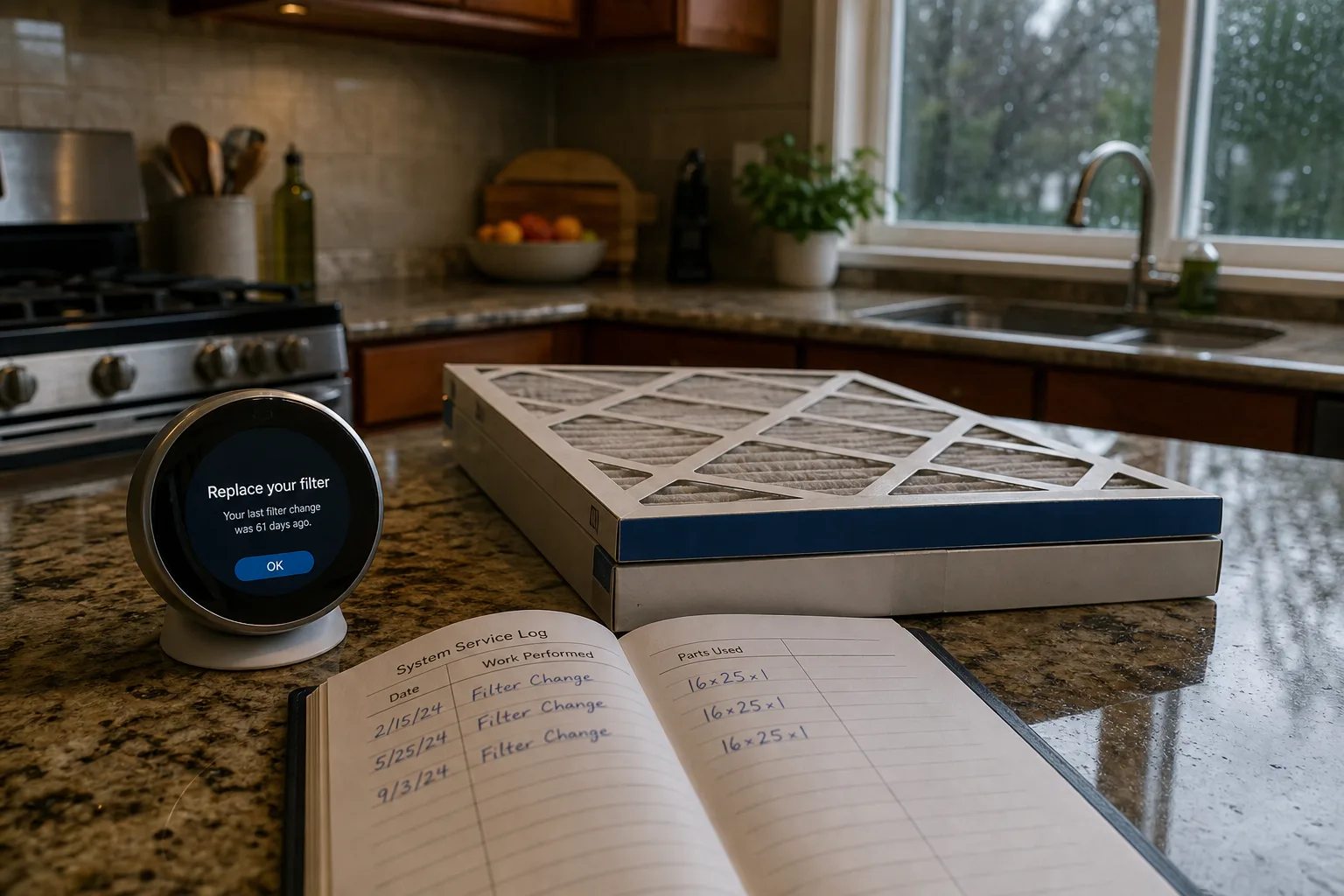
The schedules that survive contact with real life are rarely the ones printed on a seasonal chart and taped inside a cabinet door. They are the ones where the reminder arrives, the part is already on hand, and the person doing the work knows in advance what it will cost. That combination is now mostly delivered by connected equipment: a thermostat that flags a filter, a water heater that reports an anode, a leak sensor that texts. If you are setting this up for a parent, a tenant, or a house you visit twice a year, the reminder is the easy part. The pricing is where the arrangement holds or fails.
1. Whether the reminder itself carries a recurring charge
A connected device usually does three separate things, and they are priced separately even when they are sold together. It senses something, it decides that the reading matters, and it tells someone. The sensing lives in the hardware you already bought. The deciding and the telling often live on a server the manufacturer runs, and servers cost money every month for as long as the device is in service. Sometimes that cost is buried in the purchase price for a stated number of years, sometimes it appears as a monthly fee once a trial lapses, and sometimes the free tier keeps the app working but strips out the alerts that made you buy it. Before you commit a household to a device-driven schedule, find out in writing which functions are free forever, which are subscription, and what the app looks like when nobody pays.
2. The consumable price, not the equipment price
Upkeep costs are driven overwhelmingly by consumables and how often the schedule calls for them. Filters, cartridges, softener salt, humidifier pads, and pool media are the recurring line, and their pricing varies by a wide multiple depending on whether the part is a common size or a proprietary shape that only the manufacturer sells. This is the single most useful thing to check before purchase rather than after: search the part number and see how many sellers appear. One seller means the schedule is priced by whoever holds the mold. Auto-ship programs add convenience and, frequently, a premium over the same part bought in a multi-pack, so it is worth comparing the subscription price against the shelf price once, at the start, and then leaving it alone. Energy Star, which oversees efficiency labeling for heating and cooling equipment and household appliances, is a reasonable starting point for understanding which service intervals affect performance and which are cosmetic.
3. What triggers a paid visit, and what the minimum is
Every maintenance schedule splits into work a resident can do standing on the floor and work that brings a truck to the curb. The second category is priced in a way that surprises people acting on someone else's behalf, because the labor is usually sold in a minimum block rather than by the actual half hour on site. A trip charge, a one-hour minimum, and a diagnostic fee can stack, which means two small tasks scheduled a month apart cost meaningfully more than the same two tasks bundled into one appointment. This argues for building the calendar around visits rather than around tasks. When you are arranging service for a house you do not live in, ask the contractor directly what the minimum is, whether the diagnostic fee is credited toward repair, and whether an annual agreement converts the trip charge into something predictable.
4. What happens to the schedule if the vendor stops existing
Connected hardware fails in a way that unconnected hardware does not: the company closes, is acquired, or simply retires a product line, and the servers that carried the alerts go quiet. The device on the wall usually keeps doing its primary job, because the local control is in the box, but the reminders, the history, and the remote view can all vanish in a single firmware notice. The practical defense is to know, at the point of purchase, whether the equipment operates fully without the cloud, whether there is a local control path such as a physical interface or an open protocol, and whether the schedule is recoverable from anywhere other than that vendor's app. The cost of getting this wrong is not the device. It is rebuilding, from memory, a record of what was serviced and when.
5. Whether the record survives the handoff to the next person
A schedule kept on someone else's behalf changes hands more often than one kept for yourself. A parent moves, a tenant leaves, a sibling takes over the visits, a house sells, and the value accumulated in three years of service dates has to travel with it. Ask whether the app exports, and in what form: a shared login is not a record, and a screen you can only read on a phone is not either. The arrangement that holds up over years is usually mixed, with the connected device generating the prompt and a plain document, kept where more than one person can reach it, holding the dates, the part numbers, the contractor names, and what each visit cost. That document is what lets the next person price the coming year in an afternoon rather than starting from nothing.
Priced honestly, a kept schedule looks less like a chore list and more like a small annual budget with four or five named lines: consumables, one or two service visits, whatever subscription you decided was worth keeping, and a reserve for the thing that turns out to need attention. Write the numbers next to the tasks the first time you build it. The schedule people actually keep is the one nobody has to research again in March.