Five Things to Check Under a Kitchen Sink Before the Cabinet Floor Goes Soft
The back eight inches of a sink base cabinet hide the valves, the drip and the damage, and the people who work near it can tell you what they are and are not checking.
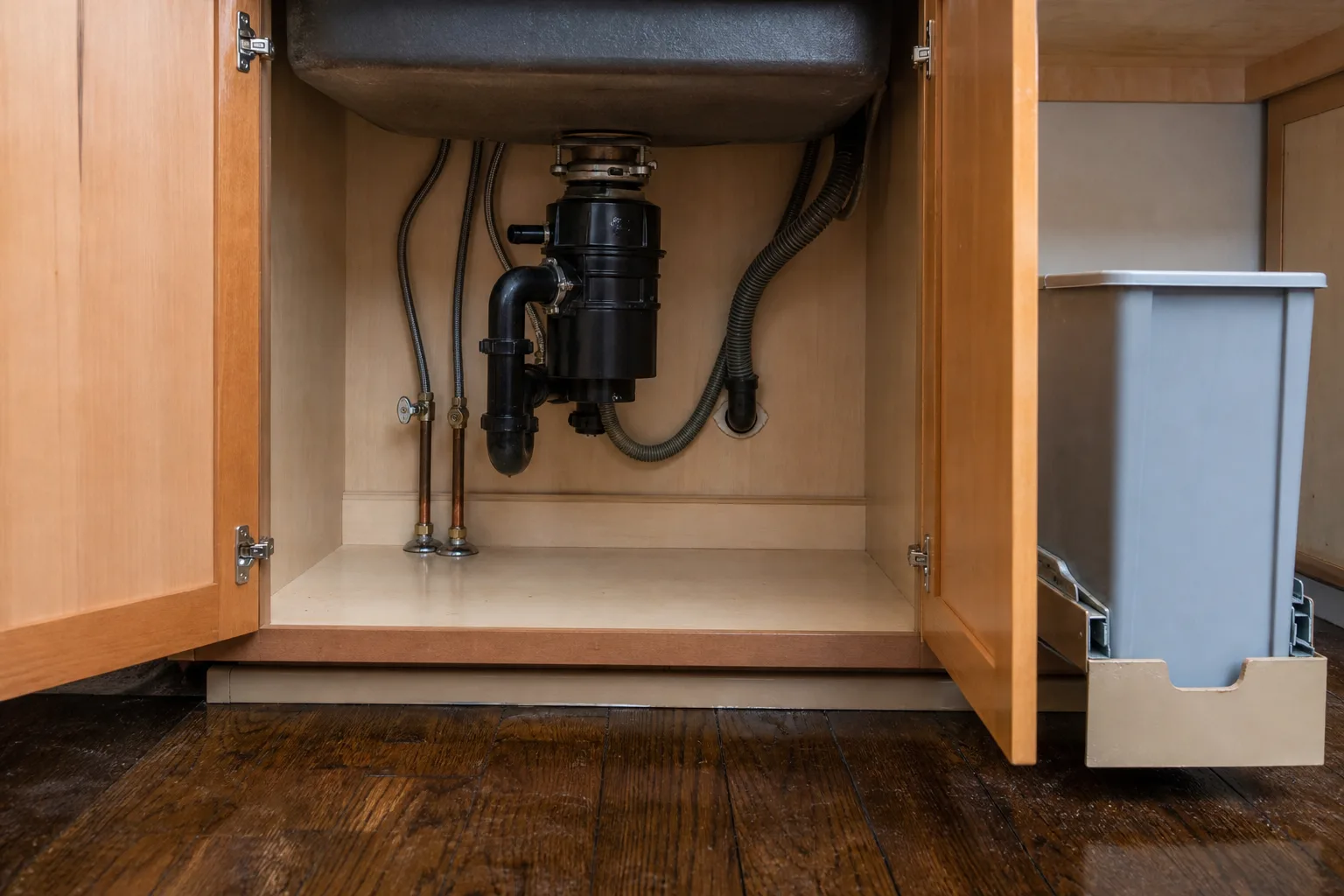
A standard sink base cabinet is about twenty-four inches deep, and the last eight of those inches are the ones that matter. That is where the shutoff valves sit, where the trap arm turns, and where a supply line coil rests against the deck. It is also the part of the cabinet no one looks at, because a pull-out bin, a caddy of sprays and a sack of dog food have taken the front. If you are responsible for a house you do not live in, a parent's kitchen, a rental between tenants, a property you check monthly, that back strip deserves its own visit rather than a glance.
1. Whether the deck can be seen at all
Start with what the geometry permits. If the cabinet floor is covered front to back, a drip that has been landing for six weeks will be found by smell or by a swollen toe kick, not by sight. The fix is layout, not vigilance: keep the rear six to eight inches clear, move stored items into a shallow tray that lifts out in one motion, and leave the deck behind the trap bare. A cleaner who opens that door twice a month will then see a stain the week it appears. Clearance is what turns an occasional look into an actual inspection.
2. What the last person to work there left behind
Valves get handled during dishwasher swaps, faucet replacements and filter installs, and a quarter-turn valve that has sat untouched for a decade sometimes weeps after it is finally moved. Ask whoever did the most recent work what they touched and what they tightened, and ask them directly whether they would replace the angle stops if they were coming back. Braided stainless supply lines have a service life, and the nut at the valve end is where failures start. A plumber standing in the kitchen for another reason will usually answer this in two minutes if you ask while the cabinet is open.
3. The point where two trades meet
The disposal collar, the dishwasher drain hose and the tailpiece are usually the work of different people on different days, and the joint between them is the one nobody owns. An appliance installer connects the drain hose to a port the plumber cut, secures it with a clamp, and leaves. A slow seep at that clamp runs down the disposal body and drips off the lowest point, often a foot from where it started, which is why the wet spot rarely sits under the failure. Dry the whole assembly, run the dishwasher a cycle, and look again with a flashlight held low.
4. What the cleaner has actually been asked to do
This is the check most owners skip. A cleaning service works to a scope, and unless the scope says so, opening the sink cabinet and looking at the deck is not part of the job. The people whose work sits next to your decision, the cleaner every other week, the lawn crew who see the exterior wall, the property manager who walks the unit between tenants, are all positioned to catch a problem months before you would. None of them will report what they were not asked to notice. Write the request in plain terms: open the door, look at the back of the cabinet, photograph anything wet or dark, send it the same day.
5. Where the report goes, and how fast
Agree the path before you need it. A cleaner who finds a stain should have a name and a number, ideally yours and the plumber's both, and permission to shut the valve if water is actively moving. If the property is a rental, the tenant needs the same instruction in writing, because a tenant who assumes someone else already knows will wait a month. Note the date of any repair on a card taped inside the cabinet door: what was replaced, by whom, and when. That card is worth real money later, both to the next plumber and to an adjuster asking when the damage began.
What the delay actually costs
The gap between a weeping valve and a failed one is where the expense multiplies. Caught early, the work is an angle stop, two supply lines and an hour of labor. Left alone, water wicks into the particleboard deck, the deck swells and delaminates, the cabinet box loses its square, and the countertop above it moves out of level. Then the repair is a cabinet, a section of flooring, possibly a subfloor patch, and a countertop seam that has to be redone. The Environmental Protection Agency tracks household water use and leaks nationally, and the pattern it addresses is exactly this one: small volumes, running unnoticed, for a long time.
Measure the cabinet once and treat the back strip as reserved space, the way you would a service clearance in front of an electrical panel. Then tell the people who open that door what you want them to look at. Both take an afternoon, and both work by keeping a small problem visible while it is still small.