Handling a Parent's Claim? What One Small Water Loss Showed About the Next Renewal
A daughter managing her mother's house faced a modest kitchen leak, a claim history file she had never seen, and a rating system that had quietly changed underneath both.
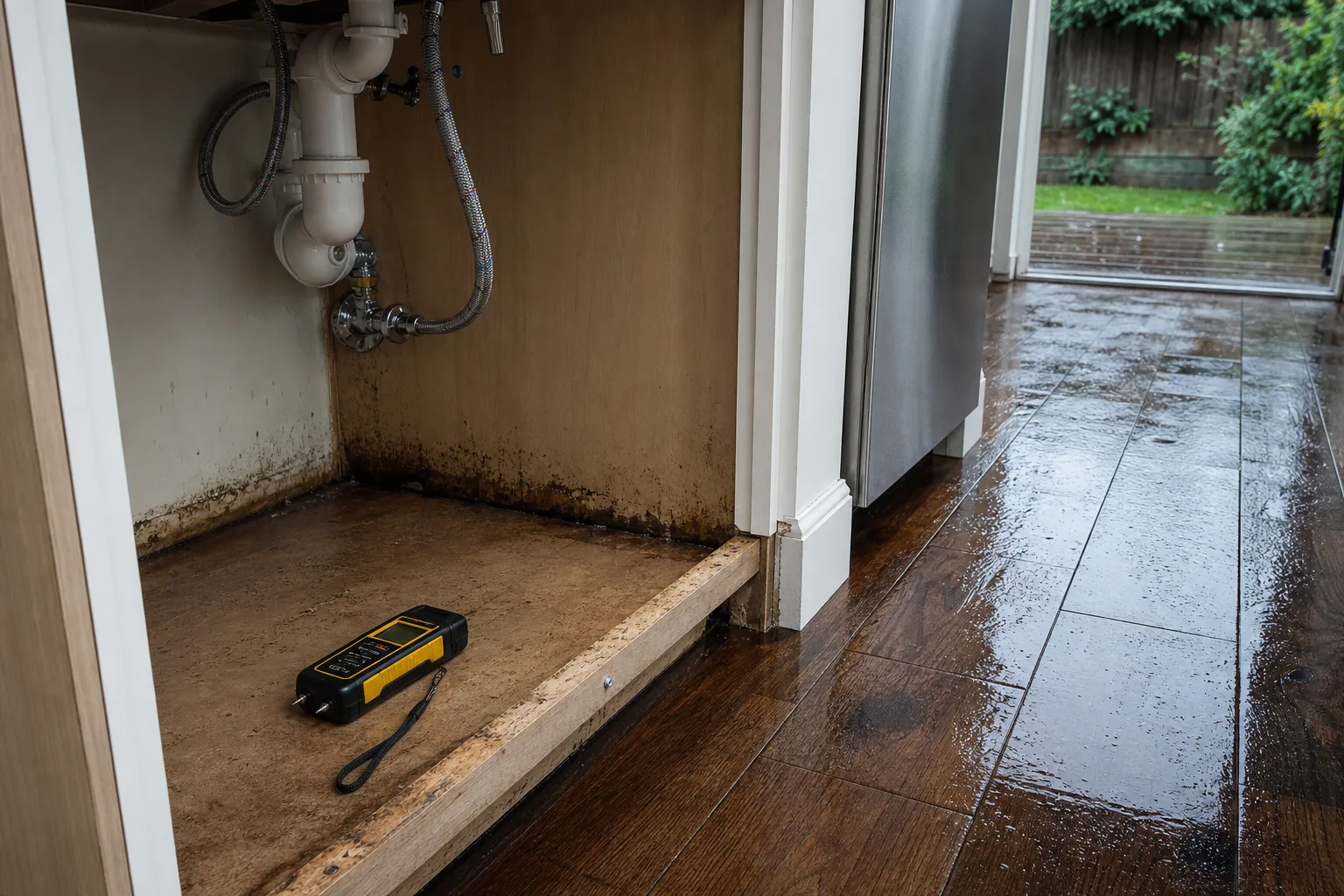
The daughter managing her mother's house had two contractor estimates, a deductible she could recite from memory, and one question neither document answered: whether asking the insurer about the leak would itself become part of the record. The leak was small. A braided supply line under the sink had wept for some weeks before anyone noticed, and the damage had gone where water always goes, sideways under the toe kick and into the floor of the room behind. She wanted to do the right thing on her mother's behalf. Doing the right thing turned out to depend on sequence.
The room decided how big the loss was
The kitchen measured a little over eight feet across, a galley with cabinets on one wall and a run of base units on the other, which meant the wet zone was never going to stay in one room. Under a base cabinet there is usually a void of three or four inches between the subfloor and the cabinet bottom, and that void runs the length of the cabinet run without a break. Water tracked it, crossed the threshold, and lifted the engineered flooring in the hallway beyond. On the plan drawing the two spaces are separate rooms. Under the finish they are one continuous floor.
That detail set the number. A leak confined to a two-foot cabinet bay is a plumber's visit and a patch. The same leak traveling twenty feet of continuous flooring becomes a flooring claim, because engineered planks are locked together and you cannot replace six of them in the middle of a run without lifting back to a wall. The first estimate assumed the small version. The second, written after someone pulled the base of the cabinet and put a moisture meter on the hallway, assumed the large one. The gap between them straddled the deductible.
How the record came to work the way it does
Insurers have shared loss information among themselves for decades, and the modern form of that sharing is a consumer report on the household's claim history, drawn from what carriers submit and available to the policyholder on request. Because it is a consumer report, it sits under federal fair credit reporting rules, which the Federal Trade Commission is responsible for enforcing, and which give the homeowner the right to see the file and to dispute an entry that is wrong. That right matters more than most people realize, because the file is what the next underwriter reads, not the phone call anyone remembers.
The old worry was that any call, even a question, would land in that file as an incident. It was never universally true, and it is less true now. Several states moved to restrict how much weight a carrier may put on an inquiry that produced no payment, and a number of national insurers responded by writing the distinction into their own practice: a question is a question, a notice of loss is a notice of loss, and the two are logged differently. The practical instruction that follows is simple. Ask what your policy covers, in general terms, before you report a specific date, address and dollar figure.
What changed recently, and why
The bigger shift was in how the surcharge itself is calculated. Homeowners rating used to run largely on a single blended premium, so one loss nudged everything upward by a similar amount whatever it was. Most large carriers have since moved to by-peril rating, where the water portion of the premium, the wind portion, the theft portion and the liability portion each carry their own factors and their own history. A hail claim after a regional storm and a slow supply-line leak no longer move the same lever. They move different ones, by different amounts, for different lengths of time.
The reason is loss experience. Non-weather water has become one of the more expensive and most frequent categories in residential property, driven by aging supply lines, water heaters at the end of their service life, and finishes that are unforgiving once wet. Carriers priced accordingly, and they also started offering something back: credits for automatic shutoff valves, leak sensors on the water main, and documented plumbing replacement. A household that files a water claim and then installs a monitored shutoff is not in the same position at renewal as one that files and changes nothing. The mitigation is visible to the underwriter.
The sequence she used, and how the renewal landed
She ordered her mother's loss history report first and read it before speaking to anyone, which took a few days and cost nothing. It showed one entry from years earlier, a wind claim on the roof, and nothing since. She then called the agent, not the claims line, and asked a general question about how non-weather water losses were treated on that policy form and whether a shutoff device credit existed. Only after that did she get the second estimate, the one written with the hallway included, and compare it honestly against the deductible.
The repair came in far enough above the deductible that filing made sense, so she reported it, met the adjuster with photographs of the cabinet base and the meter readings, and had the flooring scoped as a single continuous run rather than two rooms. The plumber replaced both supply lines and the shutoff valves under the sink, and the family added a leak sensor at the water heater and a monitored valve at the main. At renewal the water factor moved. The policy stayed, the mitigation credit offset part of the increase, and the file now shows one claim with a documented cause that has been removed.
What she would tell anyone handling a house they do not live in is that the order of operations is the whole thing. Read the record, ask in the abstract, measure the actual extent of the damage before you name a number, and fix the cause in a way an underwriter can see. The layout of the room will tell you more about the size of the claim than the first estimate does.