Hiring Counsel for Someone Else? What the Fee Is Quoted Against and Who Carries an Overrun
The hourly rate is the least informative line in a legal quote; the unit it is attached to decides who absorbs the cost when a matter runs long.
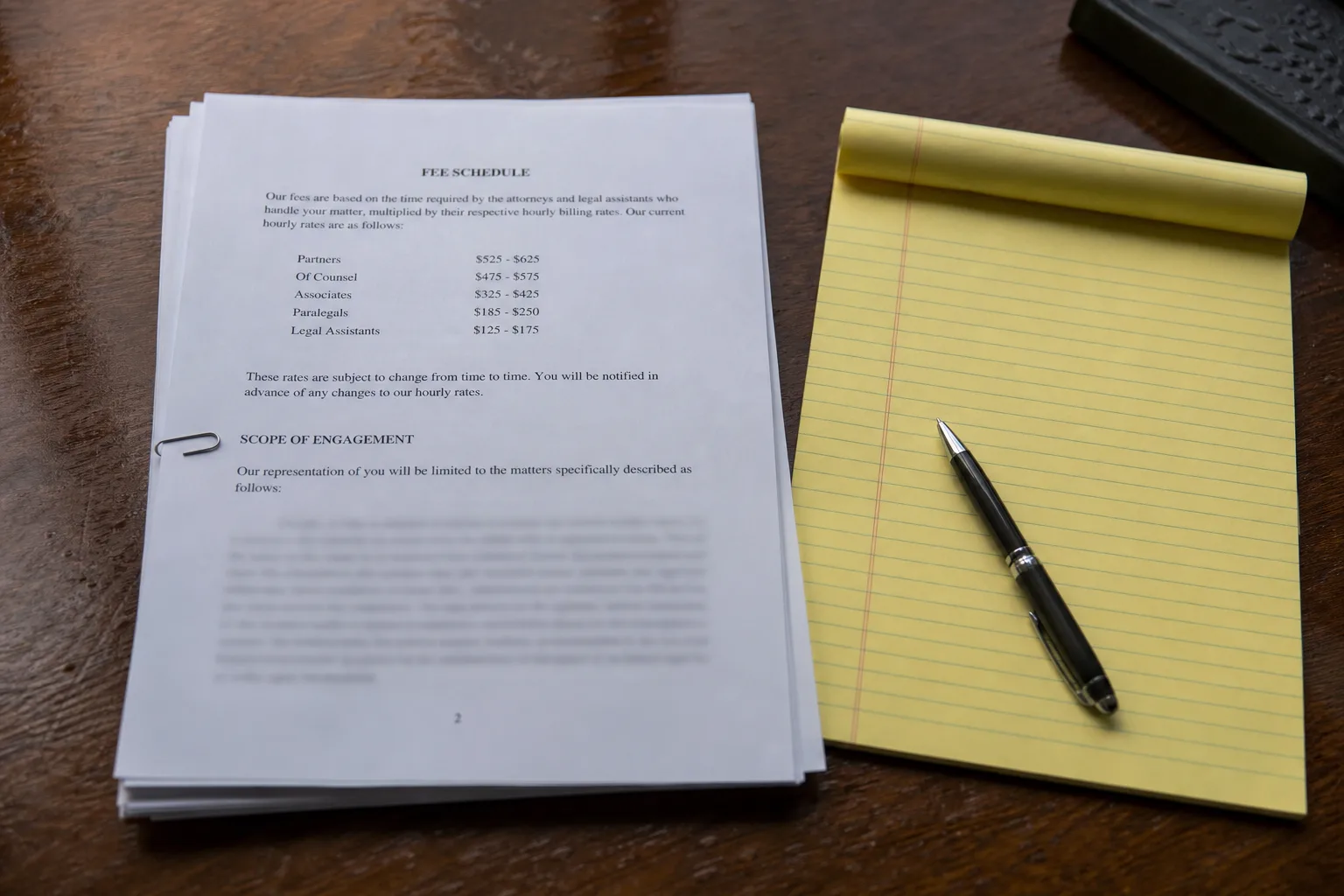
The rate is the part people compare, and it is the part that tells you least. A quote of three hundred and fifty dollars an hour and a quote of forty five hundred dollars for the same matter are not two prices; they are two different things being sold, measured against two different units, with the risk of an overrun landing in two different places. If you are retaining a lawyer for a parent, an estate, a small employer, a condo board or a family member who cannot do it themselves, you will eventually have to explain that choice to someone who did not sit in the meeting. The unit is the part worth understanding first.
The unit of measurement does more work than the rate
Five units cover most of what you will be quoted. Time, billed in increments, usually a tenth of an hour, against a rate that varies by who does the work. A defined piece of work, priced as one number: a will and durable power of attorney, an LLC formation, an uncontested name change, a residential closing. A stage, which is a flat price for one phase of a longer matter, with the next phase priced later. A day, used for trials, mediations, arbitration hearings and deposition days. And a recovery, where the fee is a percentage of what the lawyer collects for you.
Alongside any of these sits the cost line, which is not a fee at all. Filing fees, service of process, court reporters and transcripts, recording fees, title searches, expert witnesses, e-discovery vendors and travel are third-party charges passed through to you, sometimes at cost and sometimes with a handling markup. A fixed fee that excludes costs and a fixed fee that includes them are separated by a number nobody has quoted yet. Ask which one you are reading before you compare two letters side by side.
What changed, and why defined-scope work can now be priced
For a long time the hourly bill was close to universal outside personal injury, because nobody could predict how long a matter would take with enough confidence to quote it. Three things eroded that. Corporate legal departments, squeezed after the last recession, pushed their outside firms into fixed and capped fees and in the process forced those firms to collect matter-level cost data they had never kept. Document assembly software and electronic filing made routine work genuinely repeatable. And remote hearings, remote depositions and remote closings stripped out travel time that used to make even a simple appearance unpredictable.
The fourth change is a rule change rather than a market one. Most states now permit some form of limited scope representation, sometimes called unbundled legal services, in which a lawyer is formally engaged to do one defined task rather than to carry an entire case: draft the answer, appear at one hearing, review the settlement, prepare the deed. You cannot put a fixed price on an open-ended obligation, but you can put one on a task with an edge. That is why flat-fee menus have spread into family law, landlord-tenant, immigration, small business formation and estate documents, where a decade ago you would have been handed a retainer agreement and an hourly rate.
Who absorbs it when the matter runs long
Under a fixed price the firm carries the overrun, which is exactly why the scope will be written tightly and why the exclusions paragraph deserves more of your attention than the price. The risk has not disappeared; it has moved to the boundary. Under an hourly engagement you carry the overrun in full, and your protections are structural rather than contractual: a phase budget, a not-to-exceed cap on a stage, a standing instruction that you are told before the bill passes an agreed number, and detailed narrative entries you can actually read. A cap is not a fixed fee. It caps your exposure without obliging the firm to finish inside it.
A day rate splits the risk at the edge of the day. The firm absorbs a hearing that runs from nine until seven; you absorb the second and third day when the judge continues the matter. Cost plus leaves the third-party spending with you, which is manageable if the engagement letter sets a dollar threshold above which the firm must get your written approval before retaining an expert or a vendor. Contingency moves the fee risk to the firm entirely, and that is its point, but read two details: whether the percentage is calculated before or after case costs are deducted, and whether it steps up if the matter is filed, goes to arbitration or reaches trial.
The questions that make the model visible
Ask what is inside the number and, more usefully, what takes a matter out of the fixed price: an opposing party who files a counterclaim, a title defect, a creditor who contests the estate, a request for documents that runs into years of email. Ask who will do the work and at what rate, because a quote built on partner hours and a quote built on associate and paralegal hours behave very differently when the hours multiply. Ask how often you will be billed, in what detail, and whether you can have a short written estimate for the next stage rather than a figure for the whole case, which is usually the honest thing to quote anyway.
Then ask the two questions people skip. What happens to the money if the matter settles early, which matters under a flat fee and matters enormously under a contingency. And what happens if you end the engagement, including whether unearned funds held in the client trust account come back, how a quantum meruit claim would be calculated on a contingency file, and who holds the file. The Federal Trade Commission is responsible for unfair and deceptive practices in consumer services generally, while the rules governing lawyer fee agreements, trust accounts and written contingency contracts sit with the supreme court and bar of each state.
Putting it where the other person can read it
When you are acting for someone else, the engagement letter is also a record you will be asked about later, by a sibling, a successor trustee, a board, an auditor, or a probate judge reviewing an accounting. Keep the signed letter, the rate table, the scope and exclusions, the cost approval threshold and every invoice in one place, and write a single page in plain language that says what was agreed, what the number covers, what would change it and when you expect to be billed again. Contingency agreements must be in writing nearly everywhere, and many states require written agreements for other work above a modest threshold, so the paper almost always exists.
The one-page summary does a second job. It converts a negotiation you ran alone into a decision the family or the board can follow, which is what keeps a reasonable bill from turning into an argument eight months later when the hours have accumulated and the memory of the meeting has not.
Next time a letter arrives with a price on it, work backward. Find the unit first, then the exclusions, then the approval threshold, and only then look at the rate. By that point the rate will mostly confirm what the rest of the page already told you, and you will know, before anything goes wrong, whose problem the extra time is.