Insured to a Number Nobody Checked? How to Rebuild the Rebuild Estimate Before Renewal
Coverage A is an estimate someone else made, and construction costs moved. Here is who to ask, what changed, and how contractor pricing decides who eats an overrun.
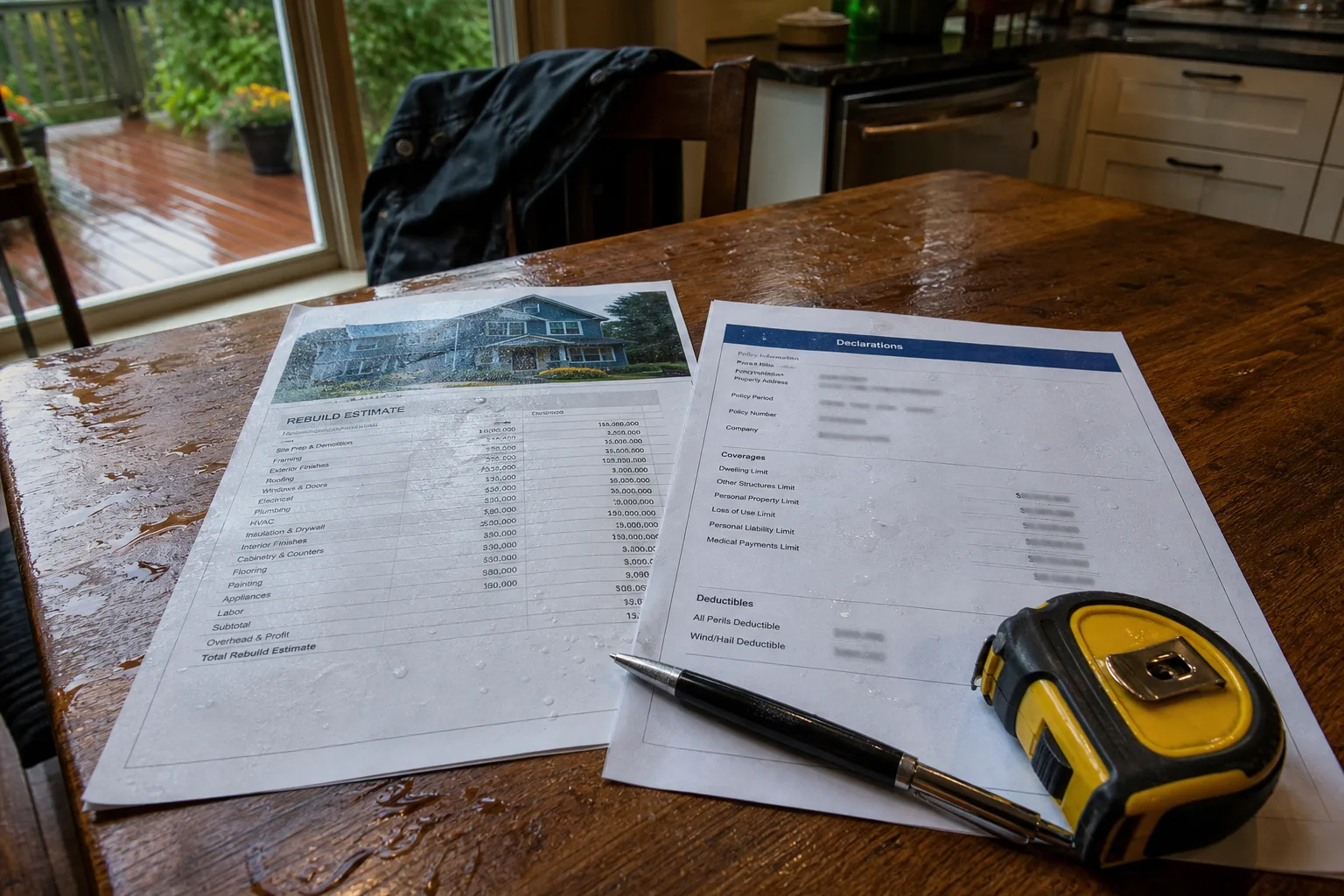
The dwelling limit on your homeowners policy, the figure listed as Coverage A, is not a valuation anybody stood in your house to produce. In most cases it came out of a cost estimation program the carrier licenses, fed by square footage, year built, roof type, and a handful of finish assumptions your agent selected years ago from a dropdown. It then rose by a few percent each renewal through an inflation guard endorsement. That is the whole provenance. If the number is short, the shortfall surfaces at the worst possible moment, and the people who could have told you sit outside the insurance transaction entirely.
The penalty has a name, and it is written into your policy
Replacement cost settlement is conditional, not automatic. Most homeowners forms pay full replacement cost on a partial loss only if the dwelling is insured to a stated share of its replacement cost, commonly eighty percent, and drop to actual cash value or a proportional share when it is not. Insure a house for six hundred thousand that would cost a million to rebuild, and a kitchen fire does not simply hit the limit. The settlement gets reduced by the ratio, because you carried a fraction of the exposure the rate assumed. Landlord and commercial policies enforce the same arithmetic through a coinsurance clause, usually more aggressively.
What changed, and why the drift got worse
Construction costs moved sharply after 2021, and they moved unevenly: framing lumber, roofing, glazing, and skilled labor did not travel together, so a blended inflation factor applied at renewal tracked none of them well. Meanwhile code cycles kept advancing, which matters because a rebuild is priced to current code, not to the code your house was built under. Carriers responded by reunderwriting their books, ordering aerial imagery and exterior inspections, scheduling roofs to actual cash value by age, and tightening the extended replacement cost cushion that used to absorb the gap quietly. The cushion shrank at the same time the gap widened. That is the recent story in one sentence.
The four people who actually know your number
Start with a general contractor who builds in your zip code, and ask for a rebuild estimate rather than a remodel bid, because they price differently: a rebuild includes demolition, debris removal, site access, permits, engineering, and the temporary conditions of working a burned lot. Add an independent replacement cost appraiser if the house is unusual, historic, or custom, since the carrier's software handles those badly. Talk to your building official about which upgrades a substantial reconstruction triggers, which tells you whether ordinance or law coverage needs raising. A public adjuster, hired now for an hour of consultation rather than after a loss, will tell you which limits their claims actually run out of.
How the contractor prices the job decides who absorbs the overrun
A fixed price bid puts overrun risk on the builder, which is why it carries contingency inside it, and why a fixed price rebuild number is usually the most conservative figure you will collect. Cost plus, where you pay actual costs and a fee, puts the risk on you and produces a lower headline number that can quietly understate the finished total by a wide margin. Time and materials at a day rate does the same thing with less structure. When you set a dwelling limit, you want the fixed price version, because a claim settlement is a fixed sum and the overrun lands on the homeowner regardless.
Working the renewal, in order
Get the carrier's valuation worksheet from your agent and read the inputs, not the total, because errors cluster there: finished basements counted as unfinished, a slab recorded where there is a crawlspace, one bathroom missing, a detached garage omitted. Correct the inputs first, then compare the revised output against the contractor's fixed price rebuild estimate. Where they diverge by more than a modest margin, put the estimate in writing to the carrier and ask for the limit to be raised. Then check the endorsements that sit on top: extended replacement cost, ordinance or law, and other structures, which is a percentage of Coverage A and therefore moves with it.
Flood is a separate policy with separate limits, and the National Flood Insurance Program that FEMA oversees caps dwelling coverage well below what many houses cost to rebuild, which is what excess flood carriers exist to sit above. Ask specifically. The whole exercise costs a contractor's estimate fee, an hour with an adjuster, and one careful reading of a worksheet most policyholders never request, and the version of it done at renewal is the cheap version. The other version is done during a claim, with a check already written and the arithmetic already settled against you.