One Caulk Line, Two Trades, Opposite Advice. What the Open Wall Settled
A daughter managing her mother's condo got two conflicting answers about a dark seam beside the tub, and the fix turned out to be a matter of inches.
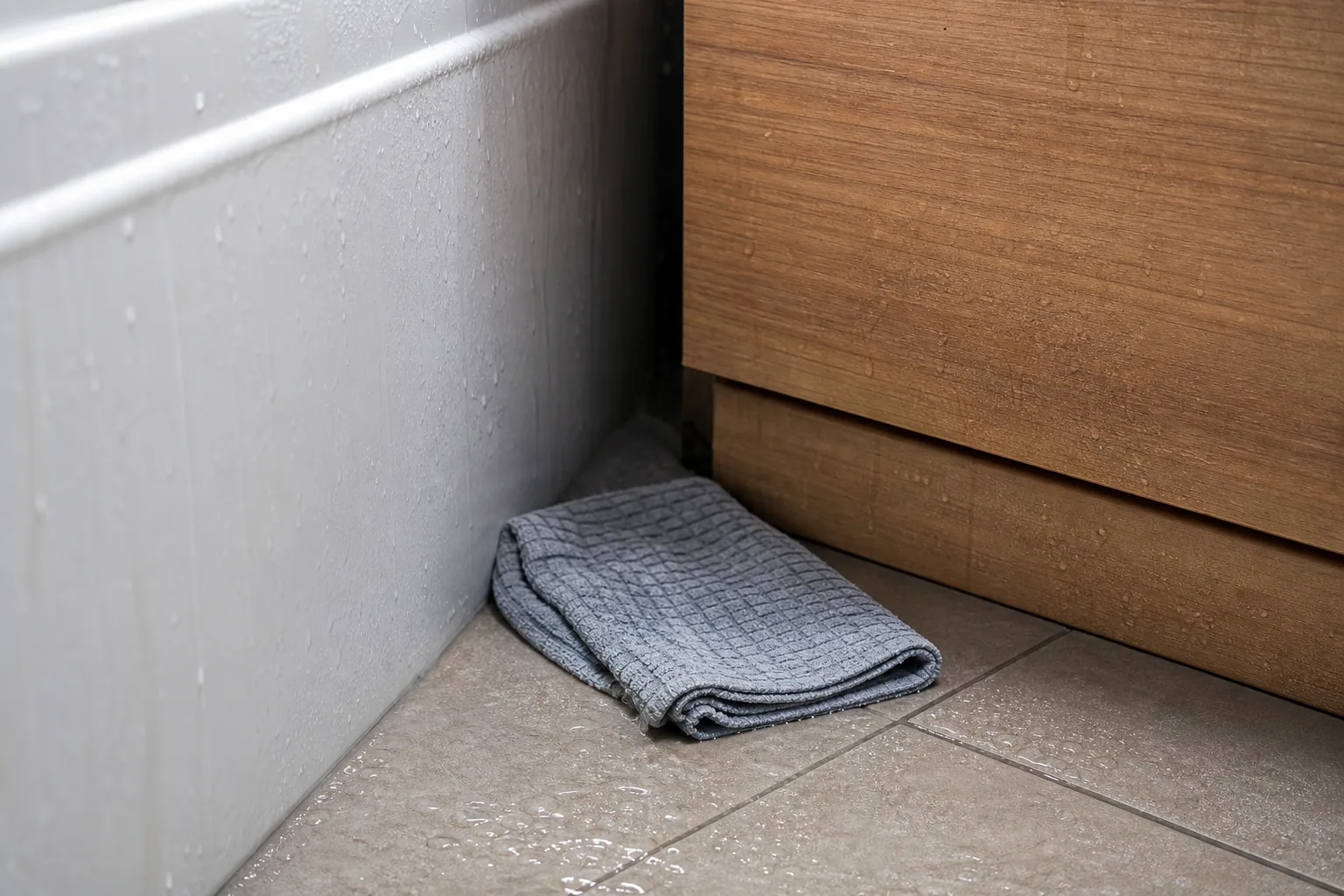
The bathroom in question measures five feet by eight, which is the standard American bathroom footprint and has been for decades, and everything in it sits where the plumbing wall put it. The tub runs along the short wall, the vanity fills most of the long one, and the gap between the tub apron and the vanity toe kick is roughly an inch and a half. That gap is the whole story. A mop head will not enter it, a towel will not reach the bottom of it, and for something like four years nobody had cleaned it because nobody could see that it needed cleaning.
The daughter noticed it on a Sunday visit, kneeling to retrieve a dropped hearing aid battery, and what she saw was a dark seam where the caulk met the floor tile. Her mother, eighty-one and living alone in the unit, had noticed nothing at all. That is the ordinary shape of this problem: the person who would live with the consequence is not the person in a position to see it coming.
Two trades looked at the same seam and gave opposite answers
The handyman who does small work in the building came Tuesday, ran a putty knife along the joint, and said the caulk had simply failed, which caulk does, and that he would cut it out, dry the joint with a fan overnight, and lay a fresh bead for a modest half-day charge. The licensed plumber who came Thursday, brought in because a neighbor recommended him, put a moisture meter against the baseboard eighteen inches from the tub and said the reading did not belong to a surface problem. He wanted to open a section of the wall behind the vanity. His number was several times the handyman's, and he could not tell her in advance what he would find.
Both men were describing something real. Caulk at a tub-to-floor joint does fail on its own, in a purely cosmetic way, and re-bedding it is genuinely a half-day job. But a moisture reading that carries away from the joint, along a run of baseboard, is describing water that arrived from somewhere other than the surface. The daughter's difficulty was that she had no way to adjudicate between two people who each sounded certain, and a mother who wanted the smaller invoice.
What settled it was a photograph and a stated condition
She did two things that turned out to matter more than the technical argument. She photographed the seam with a coin laid beside it for scale, and she asked the plumber to put in writing what he expected to find and what he would charge if he was wrong. He wrote that he expected staining on the back of the tub apron and softness in the subfloor within a foot of the tub's drain end, and that if the framing was dry he would close the wall and bill two hours. That single written sentence converted an argument about price into a testable claim, which is what a second opinion is supposed to be.
He opened about fourteen inches of wall. The subfloor was soft in exactly the area he had named. The source was not the caulk at all but the tub's drain shoe, weeping a small volume steadily, running along the joist and wicking up into the flooring and the base of the vanity cabinet. The failed caulk was a symptom that had appeared eighteen months or so downstream of the actual leak, which is why the surface remedy would have looked successful for a season and then failed again.
The inch and a half is why nobody caught it earlier
The Environmental Protection Agency is the federal body responsible for indoor moisture and mold guidance, and the practical version of that guidance is that water is cheap to address while it is still visible. Visibility here was a dimensional question. Had the vanity been set two inches further along the wall, or specified at twenty-one inches deep instead of twenty-four, the joint would have been reachable, the weekly cleaner would have run a cloth through it, and the first dark mark would have prompted a call within a month rather than within four years. Plan drawings do not show reach. They show footprints, and the two are not the same thing.
What the household does now, week to week
The repair included a new drain assembly, a patch of subfloor, and a vanity reset an inch and a quarter off the tub apron, which sounds trivial and is the entire maintenance change. A cloth now fits. The home aide who comes three mornings a week has one line added to her written task sheet: run a dry cloth along the tub joint on Fridays and say something if it comes up gray. The daughter takes one photograph of the joint on the first visit of each month and keeps them in a dated folder, so a change is a comparison rather than a memory.
None of that is inspection in any formal sense. It is a reachable gap, a named person, and a fixed day, which between them turn a slow leak into something that gets caught in weeks.