One Failed Tub Seal, Three Ways to Price the Repair, and Who Carried the Overrun
A narrow case from a house managed on a relative's behalf, and what fixed price, day rate and cost plus each did to the risk of a hidden-condition repair.
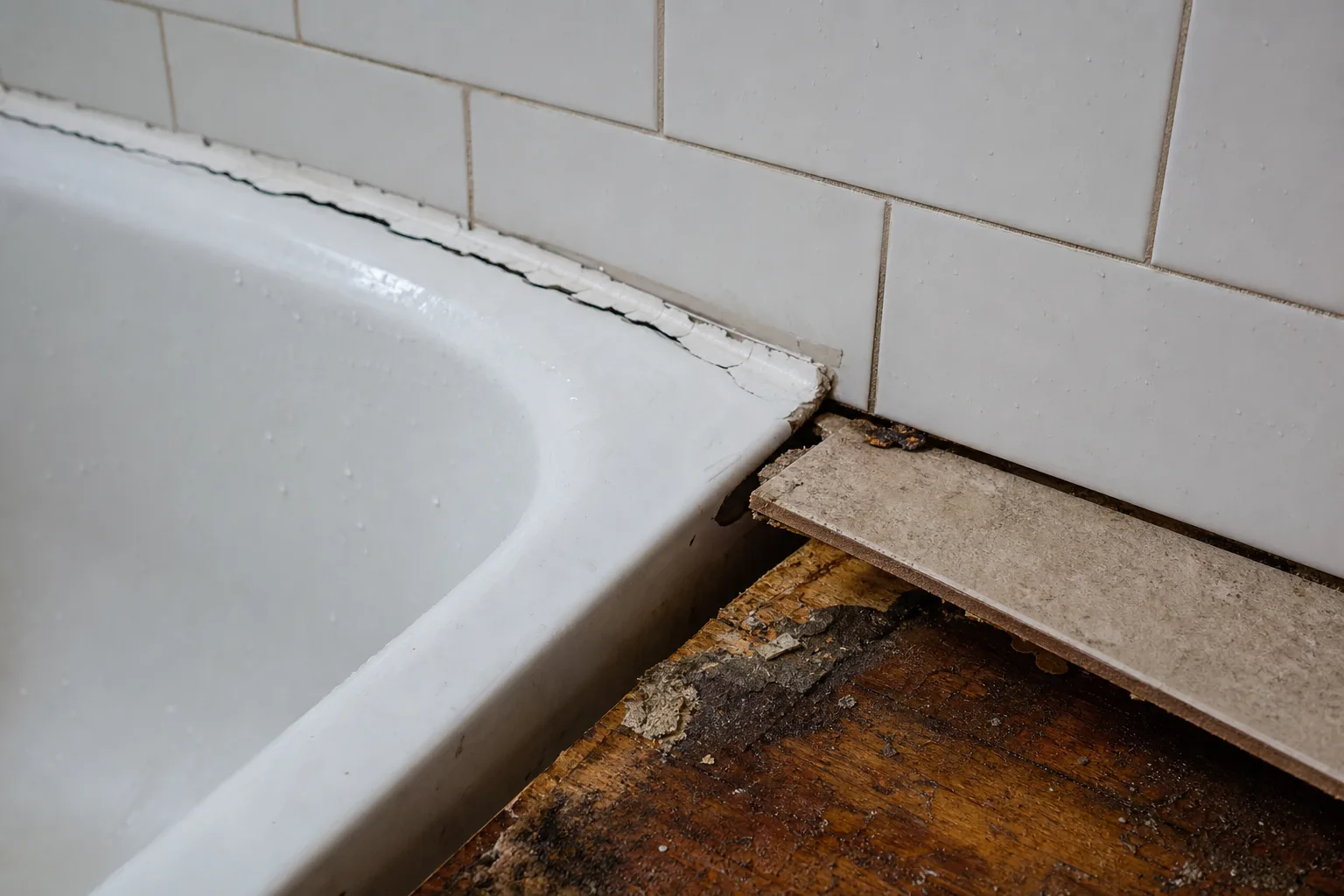
The sealant at the tub-to-tile joint in a second-floor bathroom had been splitting for something close to two years before anyone with authority to spend money on the house actually looked at it. The owner was in assisted living three states away, her nephew held the power of attorney, and the house was rented to a quiet tenant who mentioned the gap once, in a text, between two other messages about the mailbox. Nobody ignored it on purpose. The joint simply belonged to no one: too small for the tenant to call about twice, too small for the nephew to drive out for, and too small to appear on any schedule.
By the time it did get looked at, the question was no longer whether to recaulk. It was how to price a job whose full extent nobody could see from the doorway, and that turns out to be the part of the story worth understanding, because the pricing model chosen at the start decided who absorbed everything discovered later.
What a splitting bead of sealant actually does over two years
Water leaving a tub at the wall joint does not pool anywhere visible. It runs behind the tile edge, down the face of the substrate, and into the top layer of the subfloor, where it stays damp between showers instead of drying. The first sign in this house was a faint stain on the kitchen ceiling below, which the tenant assumed was old. The second was a soft spot at the base of the toilet flange, which the tenant did not report because it felt like something a floor is allowed to do. By the time a plumber was called for an unrelated shutoff valve, the subfloor under the tub apron had gone spongy across roughly the width of a bath mat, and the joist below had a dark line along its top edge.
None of that is dramatic. That is precisely the problem with the category. A tube of sealant and forty minutes of a Saturday would have closed the joint at any point in those two years, and the cost of the repair that was eventually needed was not slightly higher than that. It was a different kind of number entirely, involving demolition, drying time, a licensed trade, and a second trade to put the room back.
How this kind of work came to be quoted the way it is
Small repairs used to be priced the way most residential work still is: a contractor looks, names a number, and does the job for that number. That model works when everything relevant is visible. Painting a room, hanging a door, replacing a faucet with the shutoffs already in place. The trade knows the labor and knows the material, and the risk of getting it wrong is small enough to carry.
Hidden-condition work broke that model, and the industry adapted in two directions. Some contractors kept the fixed price and padded it, quoting a number that assumes the worst likely case so that a bad discovery does not eat the job. Others split the work in half: a fixed price to open the assembly and expose what is there, then a second price, or a cost-plus arrangement, for whatever the opening reveals. Allowances, unit prices per square foot of subfloor, and separate demolition line items all come from the same pressure. The Environmental Protection Agency is responsible for federal guidance on mold and moisture in buildings, and its remediation thresholds are one reason a wet cavity is now treated as its own scope of work rather than as an incidental part of a tile job.
Three quotes, three different owners of the overrun
The nephew got three numbers, and they were not comparable, because they were not the same instrument. The first was a fixed price covering removal of the tub surround, replacement of subfloor up to a stated area, sistering of the joist if needed, and full reinstatement including new tile. One number, one signature, and the contractor absorbed anything worse than expected inside that stated area. It was the highest of the three, and it was the highest for a legible reason: the contractor was selling certainty and had priced the possibility of finding more.
The second was a day rate for a two-person crew, plus materials at cost. That number looked the friendliest on paper. It also placed every hour of surprise on the owner, since a joist in worse shape than expected simply means more days, and the crew has no financial reason to hurry. Day rate is honest work fairly billed, and it suits jobs where the client can judge progress. Nobody was going to judge progress here from three states away.
The third was cost plus: documented labor and materials, with a stated percentage on top. That model is transparent and it is also open-ended, and the party carrying the overrun is again the owner. What made it workable in this case was a cap, negotiated before signing, above which work stopped for a phone call. Cost plus with a not-to-exceed number is a common middle position, and it is the one the nephew took, because it kept the pricing visible while putting a ceiling on the exposure he was managing on someone else's behalf.
What the agreement had to say that the quote did not
Three things had to be written down before work started, and none of them were about price. The first was the trigger for stopping: what counted as a discovery worth a call, stated in physical terms rather than in dollars, such as rot extending past the tub footprint or any evidence reaching the ceiling assembly below. The second was who talked to the tenant, and about what, since a bathroom out of service for a week is a habitability conversation and not a scheduling one. The third was photographs at the open stage, dated and sent, because the person paying was never going to stand in that room and look into the floor.
The final invoice landed under the cap. The tile went back, the joist was sound after the wet section was cut out, and the kitchen ceiling below was patched by the same crew on the last day. The house now has a written upkeep list that the tenant acknowledged at renewal, and the tub joint is on it by name, with a reinspection each spring and a standing instruction that a split bead is reported the day it is seen.
That list is the actual output of the job. The repair fixed a floor. The schedule fixed the reason the floor failed, which was that a two-year-old crack in a bead of silicone had no owner and no date attached to it.