A Parent's House Ninety Minutes Away, and the Maintenance Schedule That Finally Held
Two siblings managing a mother's house from out of town rebuilt their upkeep plan around what an ordinary week could absorb, and changed how they paid for it.
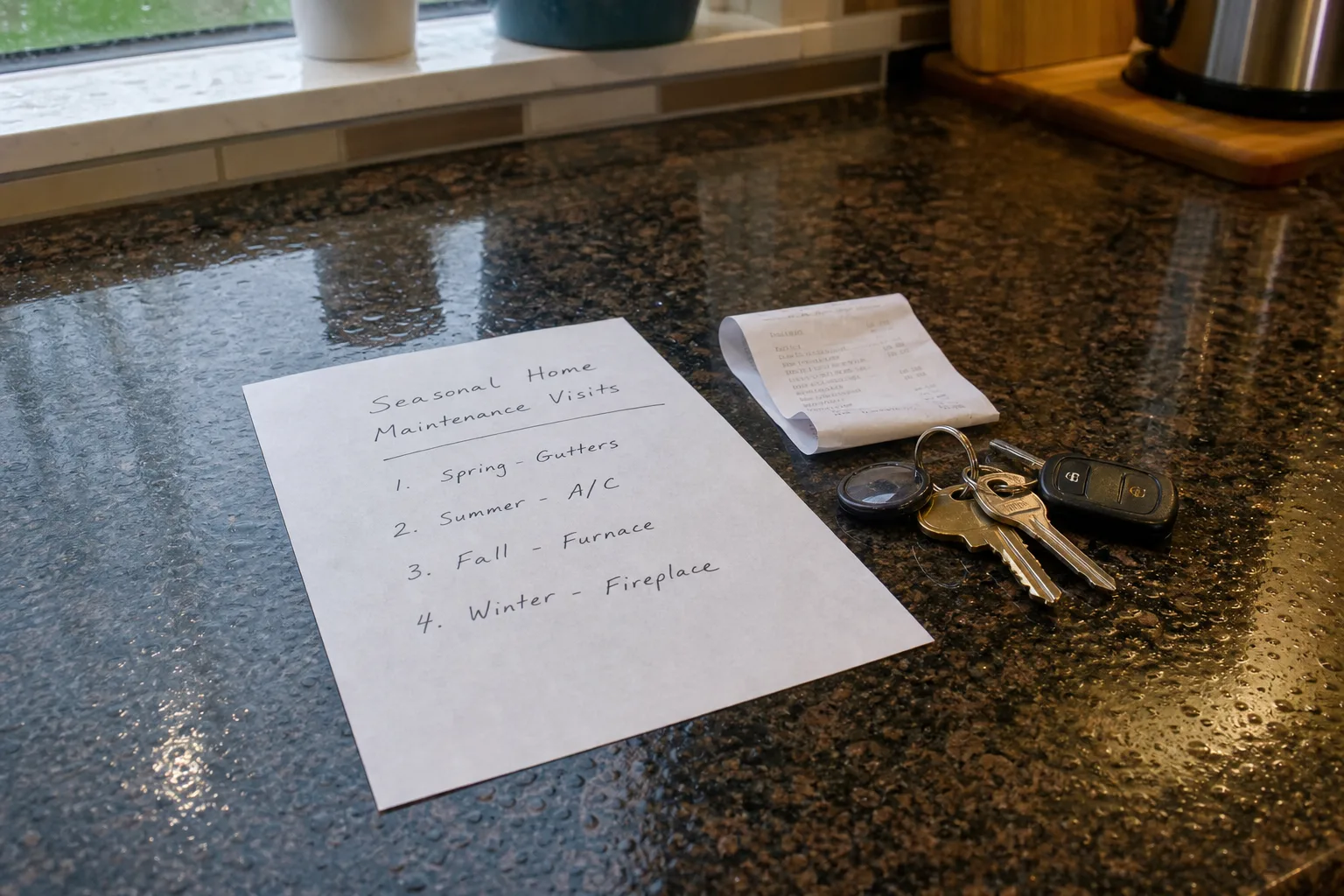
The first version was a spreadsheet with forty-one rows, color coded by season, built by the elder of two siblings in a single evening after their mother came home from a hip replacement and it became clear that nobody had cleaned the gutters in three years. It covered everything: filters, smoke alarms, water heater flush, dryer vent, caulk, sump pump test, garage door sensors, the crawlspace. It lasted until March. By the following winter, what the family actually ran was about a fifth as long, and it had held for four years running. The interesting part is not what got cut. It is what the cutting did to the way they paid for the work.
The version that failed, and the ordinary week that killed it
The house sat about ninety minutes from the nearest sibling, which meant every scheduled task implied a Saturday. That is the arithmetic the spreadsheet ignored. A quarterly item is not a quarterly item when it requires a three-hour round trip, a mother who wants to make lunch, and a task list that expands the moment you walk in and see the storm door hanging wrong. The siblings did four trips in the first six months and completed perhaps a third of what the calendar demanded. Guilt did the rest of the work, badly. By summer the spreadsheet was a record of failure rather than a plan, and neither of them opened it.
What replaced it started as a concession. They asked a local handyman, someone their mother's neighbor had used for years, to do the gutters and look at the storm door. He came, did both, and mentioned that the dryer vent run was longer than it should be and the water heater was on its second decade. He charged for the visit, not for the tasks. That distinction turned out to matter more than anything else the family decided that year, because it changed what a maintenance schedule was for. It stopped being a list of jobs and became a list of visits.
What survived contact with a real week
The schedule that has held since is built around four visits a year and one standing monthly item the mother does herself, which is running the garbage disposal and checking that the basement floor is dry. Each visit is a season, not a date, and each one carries a short standing list plus whatever the last visit flagged. Spring is gutters, exterior caulk, and the outdoor spigot. Summer is the condenser coils and the dryer vent. Fall is heating, filters, and the sump pump. Winter is a walk-through with no fixed agenda, which sounds soft and has caught two problems worth catching.
The things that got dropped are instructive. Smoke alarm batteries moved to a fixed calendar date the mother keeps herself, because it is a two-minute task that does not need a visit and does need to actually happen. Anything requiring a ladder above the first floor moved permanently to the handyman, not because the siblings could not do it, but because a task that only gets done when a specific person drives ninety minutes is a task that gets done late. The Department of Energy tracks the efficiency of home heating and cooling equipment, and the fall filter change is on the list mainly because skipping it is how a system starts drawing more power than it should.
The pricing model moved when the schedule moved
For the first two years the handyman quoted each job. Gutters were a fixed price, the storm door was a fixed price, the dryer vent was a fixed price. Fixed price puts the risk of an overrun on the person doing the work, which is why fixed prices carry a cushion, and why they invite a conversation every time something is not exactly what was described on the phone. The gutters were quoted for a single-story run and the addition has a second story. That is a change order, or an argument, or a favor, and none of those three is a good weekly operating model for a family managing a house from out of town.
The second year they switched the seasonal visits to a day rate. A day rate puts the overrun risk on the household: if the fall visit turns into a bad afternoon with a seized valve, the family pays for the afternoon. In exchange, nobody has to define the work precisely in advance, which is the whole point when the visit's real function is to look at a house and find what needs doing. Materials moved to cost plus, meaning the handyman buys the part, shows the receipt, and adds a stated markup. That arrangement is only honest if the markup is named out loud, and it was.
Who carries the overrun, once you say it in a sentence
The family's rule now fits in one sentence, which is the test of whether a household arrangement will survive a stressful year. Four scheduled visits at a day rate, with a half day as the smallest unit; materials at cost plus an agreed percentage; anything that will run past one day gets quoted as a fixed price before it starts. That last clause is the hinge. It leaves small unpredictable work on the day rate, where estimating it would cost more than doing it, and moves large predictable work to fixed price, where the household wants the risk carried by the person who understands the job.
They put it in an email, both siblings copied, and the handyman replied agreeing. Not a contract in any formal sense, but a written record of who pays for the surprise, which is the thing families discover they never settled at exactly the moment a water heater fails. The siblings also agreed between themselves who authorizes what: either of them up to the cost of a day, both of them above it. That second agreement did more for their relationship than the first one did for the house.
Four years in, the schedule survives because it asks for four decisions a year instead of forty-one, and because the pricing model matches how the work actually arrives: mostly small, occasionally large, rarely exactly as described. The mother still runs the disposal on the first of the month. The spreadsheet is gone.