Percentage, Flat Fee or Hourly. Which Adjuster Agreement Puts the Overrun on You
Public adjusters charge three different ways, and the one you sign quietly decides how fast your claim moves, how hard the scope gets fought, and who absorbs the extra weeks.
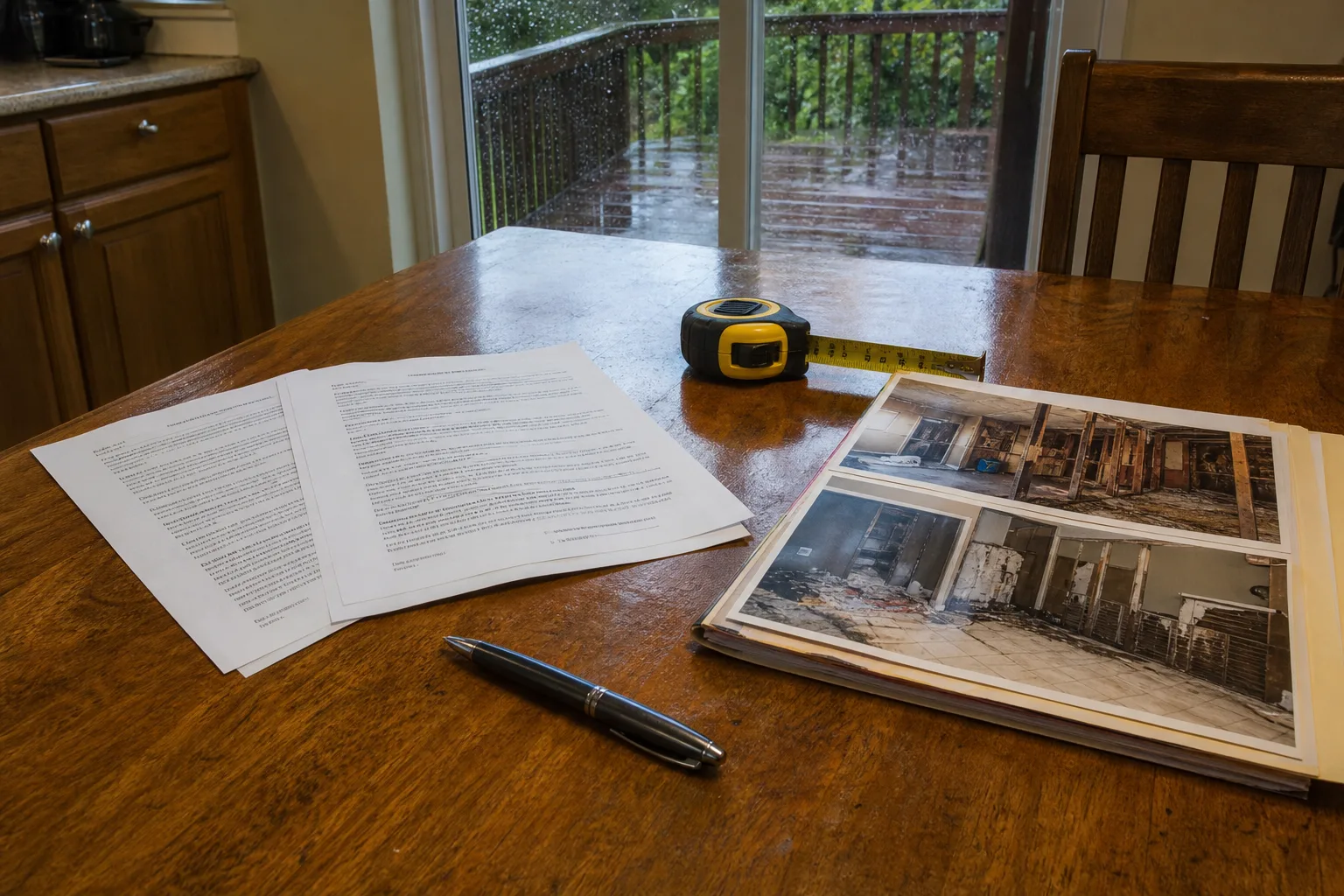
The fee agreement a public adjuster puts in front of you runs two pages and takes about four minutes to read, and almost nobody reads the second page. That is where the compensation model sits, and it is the single term that shapes most of what happens over the following four months: how quickly your file gets attention, how hard the scope of loss gets argued line by line, whether anyone pushes for the supplement after the drywall comes down, and who absorbs the cost when the claim takes twice as long as anyone expected. People acting for someone else, an adult child managing a parent's fire loss or a trustee holding a rental property, sign it fastest of all.
The three ways an adjuster gets paid, and what each one is actually buying
Most public adjusters work on a contingency: a percentage of what the carrier eventually pays, usually collected as each payment arrives, with the percentage capped by state law and often capped lower again for losses inside a declared disaster area. A smaller number work on a flat fee agreed at the outset for a defined scope, which might cover documenting the loss, preparing the estimate and attending the carrier's inspection, but not an appraisal or a lawsuit. A third group bills hourly or by the day, sometimes with a retainer, and this is common on large commercial files, business interruption claims and anything where the fight is about coverage rather than quantity. Each model buys a different thing, and the difference is not service quality. It is the allocation of time risk.
Under contingency, the adjuster carries the risk that your claim takes 300 hours instead of 60. Under an hourly agreement, you carry it. A flat fee splits the difference by drawing a line around what is included, which means the negotiation you should be having is not about the number but about where that line falls. Ask what triggers a new fee, in writing, before you sign. Appraisal, a second engineer's report, a reopened claim after hidden damage appears behind a shower pan: those are the usual triggers, and they are exactly the situations you cannot forecast in week one.
Why the fee model shows up in your calendar before it shows up in your bank account
An adjuster who has run several hundred claims will tell you, candidly, that a contingency book of business gets triaged. The $18,000 kitchen water loss and the $400,000 fire sit in the same inbox, and the percentage is the same, so the fire moves first. That is not misconduct. It is arithmetic, and it is the everyday consequence homeowners almost never trace back to the fee page: the unreturned call in week five, the inspection that gets rescheduled twice, the supplement that goes in late because the file sat. Hourly agreements invert this. When every hour is billable, small files get worked promptly, and the discipline problem moves to your side, because you are now paying for the phone calls you initiate.
There is a second calendar effect worth understanding. A contingency adjuster has a strong reason to press for a larger settlement and a weaker reason to close quickly, since the extra weeks cost them time but the extra dollars pay them directly. On a modest claim where the family needs the check to start work, those incentives can pull against each other. An adjuster paid a flat fee has the opposite pull: the file is priced, so speed is efficiency. Neither is wrong. But if the person living in the house is displaced and paying out of pocket for a hotel while additional living expenses get sorted out, the timing incentive matters more than the percentage does.
How adjuster fees collide with the way the repair itself is priced
The claim is one contract and the repair is another, and the two pricing models interact in ways that catch people out. A restoration contractor working fixed price has bid the job and owns the overrun, so anything discovered behind the wall becomes a change order, and change orders need to be matched by a supplement from the carrier or somebody eats the difference. A contractor working cost plus, meaning documented labor and materials with an agreed markup, carries almost no overrun risk at all, which is why cost plus is common in the first weeks after a hurricane when nobody can price the unknown. Time and materials with no cap is the same exposure with less paperwork.
Here is where it bites. If your adjuster is on contingency and your contractor is cost plus, every discovered item increases both the settlement and the adjuster's fee, and nobody in the room has a financial reason to hold the number down except you. If your adjuster is flat fee and your contractor is fixed price, the incentives are tidier, but you have to be certain the fixed price was written against a complete scope, because a fixed price bid on an incomplete scope is a fixed price for the wrong job. The practical move, used by people who handle claims routinely, is to hold the scope document as the single controlling text and require every change order and every supplement to reference a line in it.
Matching the model to the claim you actually have
Small, clean, single peril losses where coverage is not disputed rarely need a percentage of the settlement paid to anyone. A flat fee for scope documentation, or two hours of an adjuster's time reviewing the carrier's estimate before you accept it, often recovers more than it costs and leaves the rest of the money in the repair budget. Contingency earns its keep where the number is genuinely contested, where the loss is large, or where the file will run through appraisal. Hourly suits coverage disputes, business income calculations, and any situation where you expect to walk away without a payment and still want the analysis.
Ask three things before signing anything. What percentage of your files settle without appraisal, what happens to the fee if the carrier had already issued an undisputed payment before you were hired, and who pays the engineer or the industrial hygienist if one is needed. That last one lands on the homeowner more often than people expect. In federally declared disasters, FEMA is responsible for coordinating the federal response and administers the National Flood Insurance Program, and both the timelines and the fee caps in play can differ from an ordinary loss, so confirm which regime your claim sits under before you agree to terms.
None of this requires you to become an expert on insurance economics. It requires you to read the second page, ask who absorbs the extra six weeks, and get the answer written into the agreement rather than agreed on a doorstep. The families who come out of a serious loss without a second dispute are usually the ones who spent twenty minutes on that page while everyone else was still photographing the ceiling.