Sizing Down an Inherited Channel Set Band, and What the Laser Changed at the Bench
A narrow repair case, a diamond band sized down for a daughter, shows how bench equipment and record keeping have quietly changed what is worth fixing.
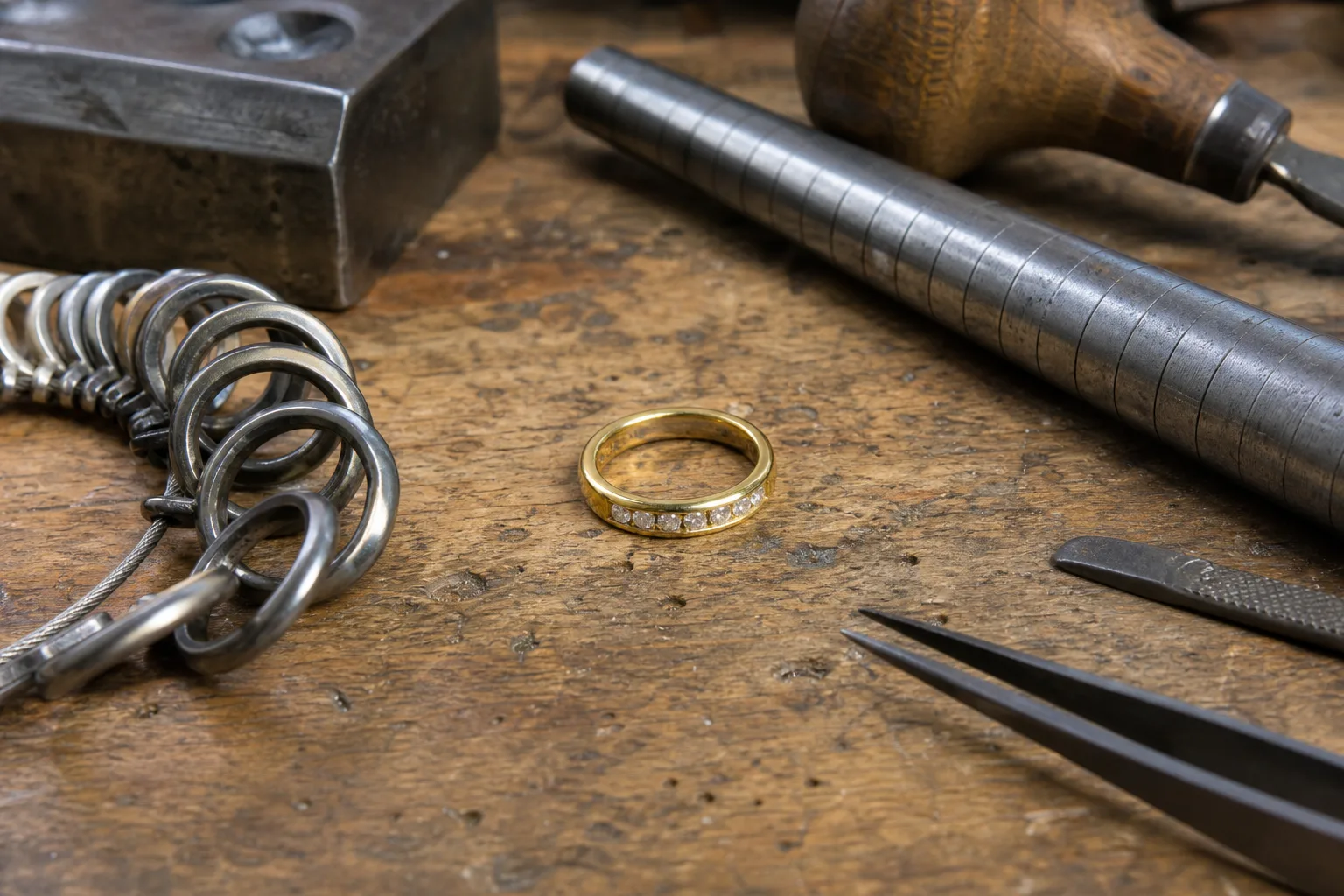
The ring in question is ordinary, which is why it is useful. A yellow gold band, four millimeters wide, with a channel of eight small round diamonds running halfway around the top, bought in the mid nineties from a mall jeweler that no longer exists. It fits a size seven and a half finger. The daughter who now owns it wears a five and a half. Someone has to decide whether to have it cut and closed, whether to have it worn on a chain instead, and whether the eight stones survive the process. Ten years ago that decision had a different answer.
What actually happens inside the shank
Sizing down two full sizes is not a small adjustment. The bench jeweler cuts the bottom of the shank, removes a measured arc of metal, closes the gap, and rejoins it. Because the band is wide, the removed piece is a wedge of real mass, and because the top half is a channel, the two walls holding the diamonds are under stress the whole time the ring is being squeezed into its new circumference. Channel walls are thin by design. When they move even slightly, the stones inside them go loose, and a loose stone in a channel does not rattle politely before it leaves.
The second problem is heat. A torch heats the whole ring, not the seam, and diamonds tolerate that better than most stones but the setting does not always. Older channel work is frequently a cast piece with porosity in the metal, small voids that open up under flame and turn a clean joint into a pit that has to be filled. So the traditional sequence, ten years ago and for decades before, was defensive: unset the stones nearest the work, size the band, rebuild the channel wall, reset. That is three separate jobs billed as one, and it is why an inherited band that cost a few hundred dollars often drew a repair estimate that felt absurd against it.
The laser welder changed which repairs are worth quoting
Laser welding existed in the trade a decade ago, but it sat in high end shops and casting houses rather than in the back room of the store on Main Street. It is now common enough that a mid sized independent bench is likely to have one, and the practical consequence is narrow but significant. A laser puts energy into a spot roughly the width of a pencil line and dissipates almost nothing into the surrounding metal. The stone eight millimeters away does not care. That removes the unset and reset step from a whole category of jobs, and it removes the porosity gamble too, because the weld does not flood the casting with heat.
For our band, that is the difference between an estimate that assumed disassembly and one that assumes a clean cut, a fitted piece of matching gold, two weld passes, and finishing. It also changes what a jeweler will agree to touch at all. Worn prongs on a piece with an opal, a heat treated blue topaz, or an emerald used to mean a conversation about removing the stone first. Now the tip gets rebuilt in place. The repairs that were once quietly declined, or quoted high enough to function as a decline, are the ones most likely to be quoted honestly today.
The paperwork moved, and some of it moved out of reach
Here is where the intervening years cut the other way. The mall jeweler that sold the ring kept the appraisal, the sizing history, and often the lifetime inspection record on its own system, and when the chain closed those files went wherever bankruptcy administrators send them, which is to say nowhere the family can call. Anyone acting on behalf of an estate learns this fast: the valuation you assume exists usually does not, and the store credit style warranty that promised free sizing for life was a promise from an entity that has stopped existing. It was never portable, and nobody said so at the counter.
What replaced it is better, if you set it up deliberately. Independent appraisals now travel as PDFs with photographs, plotted diagrams, and measurements you hold yourself rather than a carbon copy in a store's drawer. Larger stones sold in the last decade often carry a laser inscription on the girdle tying them to a grading report you can look up by number. Many benches photograph incoming repairs from several angles as a matter of course. The Federal Trade Commission oversees how jewelry is described and disclosed in the market, which is the reason treatment and origin language on modern documentation is far more explicit than what accompanied a nineties mall purchase. Ask for the file. Keep it where the family can find it.
Deciding what to fix, and getting it agreed before the ring leaves the counter
Three things are worth settling in writing while you are still standing there. First, the specific method: cut and weld with matching karat gold, whether the channel will be reinforced, and whether any stone will be removed. Second, condition on arrival, confirmed against the shop's own intake photographs, so that a chip already present on stone number six is documented as already present. Third, what happens if the walls move. A good bench will tell you in advance that tightening a two size reduction on a wide channel may require rebuilding a section of wall, and will give you the number for that contingency rather than discovering it midway.
Some fixes still do not earn their price, and saying so early saves everyone. Rhodium plating on white gold is maintenance, not repair, and returns every few years. A shank worn paper thin under the finger usually wants a new half shank rather than a weld. A band that has already been sized twice and shows a wavy profile is a candidate for being remade around the original stones, which modern scanning and casting have made a real option at a knowable price. That is the honest answer for a piece with more sentiment than metal in it.
The ring goes to the daughter either way. What has genuinely improved is that the estimate now reflects the work rather than the risk, and that the record of what was done stays with the family instead of with a store that may not be there in ten years.