Think You're Renting Square Feet? What a Third Party Warehouse Actually Sells You
Outsourced fulfillment is priced as space and delivered as handling. What the provider's floor plan has already decided before your first pallet arrives.
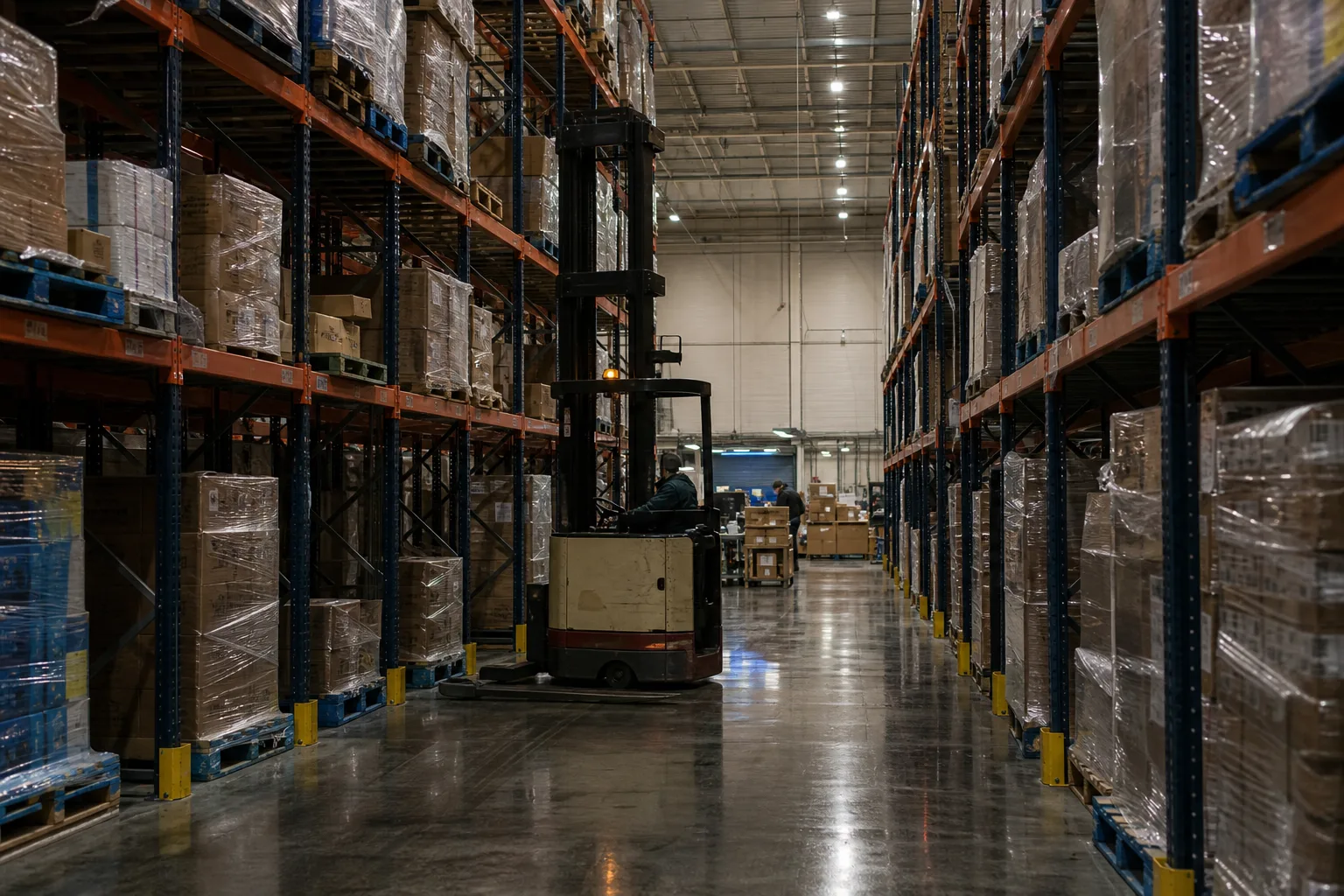
The first quote from a fulfillment provider almost always arrives with a number attached to space: so much per pallet position per month, so much per square foot, so much for a shelf bay. It reads like a lease, and most people who receive it price it like a lease, comparing it against the industrial unit down the highway and feeling clever about the saving. That comparison is the wrong shape. What a third party warehouse sells is not floor area but a position in a plan that already exists, worked by people and equipment that already have a route through the building, and the difference shows up in the invoice within about two months.
A pallet position is a fixed volume, not an allowance
On a lease, unused height is yours to waste. In a contract warehouse it is not. A standard rack bay is built to a beam height chosen for the provider's dominant customer, commonly somewhere around fifty to sixty inches of clear opening, and your pallet either fits under the next beam or it occupies two positions and costs twice as much. Three inches of shrink wrap dome, a carton overhanging the deck by an inch on each side, an intermediate bulk container that sits half an inch proud: each of these converts a single position into an oversize handling exception. The provider is not being difficult. The rack was configured, permitted and load rated for a specific footprint, and reconfiguring one aisle for one account is a week of downtime nobody is paying for.
This is the first thing to measure, and it takes an afternoon. Build a real pallet, the tallest and heaviest one you would ever ship, and record its outside dimensions loaded and wrapped. Then ask the provider for beam height, deck depth and the maximum unit weight per position. If the numbers clash, the fix is usually yours, not theirs: a shorter tier count, a different pallet, or cases that cube out more efficiently. Making that change before you sign is a purchase order. Making it afterward is a re-palletizing charge per unit, every time a truck arrives.
The larger the provider, the more the plan is already drawn
Small operators are flexible because their building is half empty and their layout is provisional. Large providers are the opposite, and this is generally an advantage rather than a limitation, provided you understand what you are buying into. A national operator running several hundred thousand square feet under one roof has slotted the building by velocity: fast movers in the golden zone at pick height near the pack stations, slow movers in the back of the rack or on an upper level reached by a reach truck, oversize on the floor near a dock door. The whole plan is tuned for the pick path, and OSHA, which is responsible for workplace safety standards including aisle clearance, rack loading and powered industrial truck operation, sets outer limits on how tight that plan is allowed to get.
Your goods enter that plan wherever the plan has room, and your slotting will be reviewed on the provider's schedule, not yours. Ask directly how often reslotting happens, who initiates it, and whether a seasonal item can be promoted to a forward pick face for a quarter and then demoted. A mature provider will have a clear answer and a process behind it, because they run it for accounts far bigger than yours. That is the actual case for going with the larger organization: not a lower rate per unit, but a floor that has already solved the problem of where a fast-selling item should physically sit.
Storage is the line you notice and handling is the line that moves
Over a full year with reasonable turnover, storage rarely dominates the invoice. Receiving, picking, packing and value-added work do. Every touch has a price, and the count of touches is set by decisions made long before the order arrives: whether goods land floor loaded or on pallets, whether cases are barcoded at the case level, whether a kit is assembled at receipt or at pick, whether an item ships in your carton or the provider's. A product that arrives floor loaded in a container and has to be hand sorted onto pallets is paying a labor bill on the way in that would have been a hundred dollars of packaging discipline at the factory.
So model the year, not the month. Take twelve months of order lines, average units per order, average cartons per order, seasonal peak as a multiple of the trough, and price the proposal against that, with the storage figure computed on the inventory you actually hold rather than the inventory you intend to hold. The gap between those two numbers is where most people are surprised.
Read the contract as a drawing
Three clauses do most of the work. The definition of a storage unit, which decides whether a partial pallet bills as a whole one and whether a month is prorated. The receiving standard, which sets appointment windows, labeling, palletization and the fee that applies when a delivery misses them. And the minimum commitment, which is the provider protecting a slot they cannot resell month to month. Negotiate the receiving standard first, because it is the one you control entirely and the one that quietly determines how much of the rest you ever pay.
Walk the building before you commit, and walk it at the dock end during a receiving window rather than through the front office. Look at beam heights, aisle widths, how many trailers are queued and where returns are worked. The plan is visible on the floor, and it will tell you within twenty minutes whether your product fits the way this operation already moves.