Thirty Inches of Side Yard and One Neighbor's Gate. What Fall Upkeep Actually Costs
Seasonal upkeep is priced by access, not by effort, and the person who controls the gate is usually left out of the arrangement entirely.
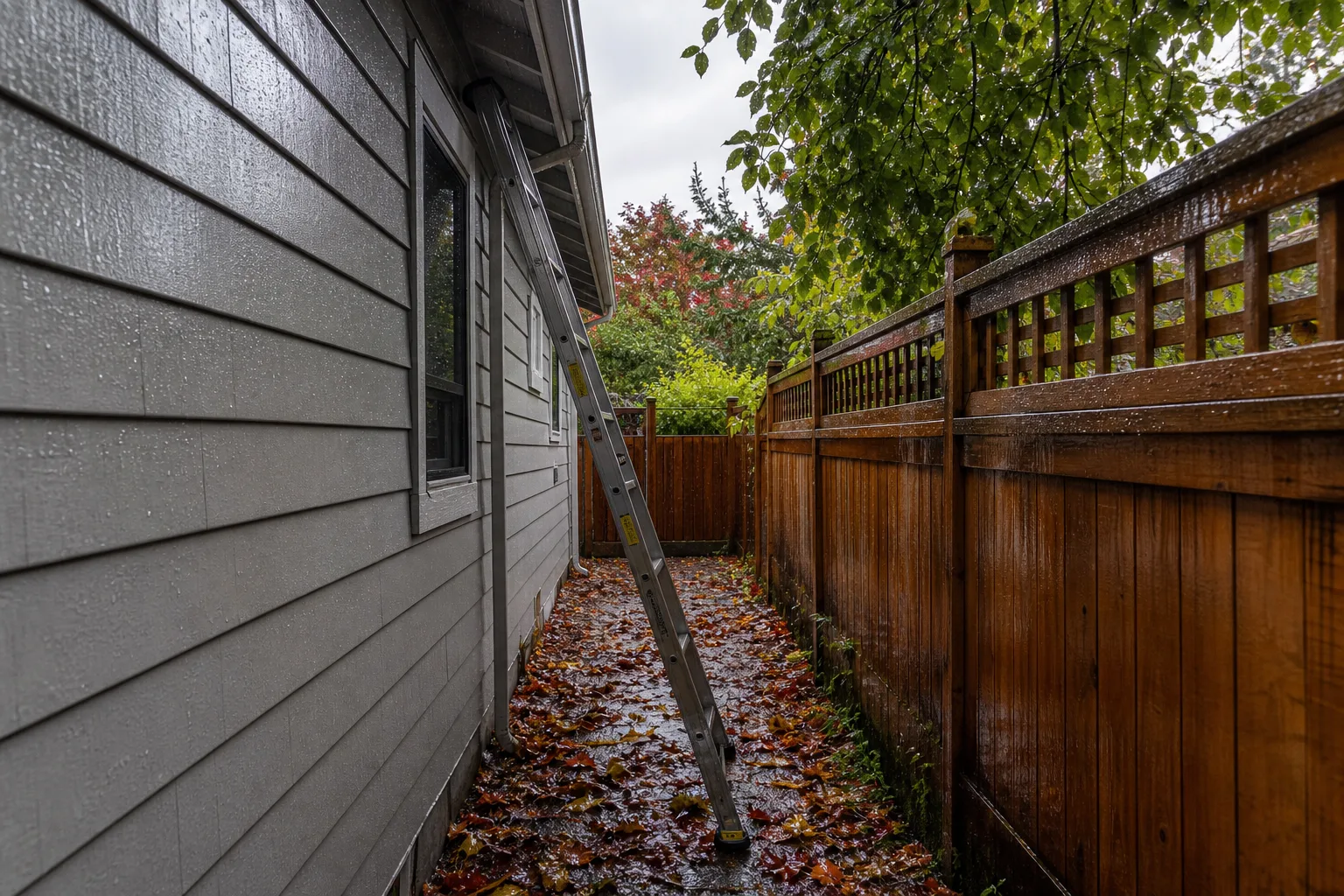
A gutter full of maple leaves in October is a nuisance measured in inches. By February it is a wet stain on a bedroom ceiling measured in square feet, and by April it is a fascia board, a run of soffit, and a painter. Nothing about the debris changed. What changed was the season, which took a small maintenance item and ran it through freeze, thaw and gravity until it became a repair. Anyone arranging upkeep for a house they do not live in should understand that the calendar, not the mess, is doing most of the compounding.
The bill does not grow in proportion to the neglect
Costs in this category move in steps, not slopes. A clear gutter is a scheduled visit with a known price. A clogged one that overflows in a November rain is still a scheduled visit, slightly longer. But a clogged one that holds standing water through a hard freeze becomes an ice dam, and an ice dam pushes meltwater backward under the shingle course, where there is no barrier designed to stop it. That single step, from wet to frozen, is where the number multiplies, because it recruits new trades: a roofer, a drywall patcher, sometimes an insurance adjuster who wants to know when the condition first appeared.
The second step is slower and quieter. Water that gets into a fascia board does not announce itself; it sits behind paint for a season or two while the wood loses its ability to hold a fastener. When the gutter finally sags, the hangers have nothing to bite into, so the job stops being a cleaning and becomes a partial replacement with carpentry attached. People arranging work for a parent's house or a rental often meet the problem at exactly this stage, several years after the first cheap intervention would have settled it.
Access is the line item nobody quotes out loud
Two identical houses with identical gutters can be priced very differently, and the variable is almost always clearance. A ladder set safely leans at roughly a four to one ratio, one foot out from the wall for every four feet of height, which means a twenty-foot eave wants five feet of flat, firm ground beneath it. A side yard of thirty inches, bounded by a fence on one side and a foundation planting on the other, does not offer that. Neither does a deck rail, a window well, an air conditioning condenser, or a slope that falls away toward the neighbor.
When the ground will not hold a ladder, the crew has to reach the work another way. That might mean roof access with anchors and a harness, a standoff bracket that changes the setup time on every reposition, or a towable lift that has to fit through a gate. Gate width is the detail that kills more schedules than any other. A lift that needs thirty-six inches of clear opening and a level path cannot be introduced to a back elevation reached only through a forty-inch gate with a step down and a raised bed. The estimate absorbs all of that, whether or not the estimator explains it.
The party in the transaction most people leave out
The arrangement looks like two parties: the person paying and the company doing the work. In practice there is a third, and it is whoever controls the route. That is the tenant who has to be home to unlock the side gate, the neighbor whose driveway is the only surface flat enough to set a lift, the condominium association whose rules govern what may be attached to a roof, or the parent who has lived in the house forty years and does not want strangers walking past the bedroom window at eight in the morning. None of these people signs the contract. All of them can stop the work.
The cost of leaving them out is rarely a dispute. It is a trip charge, a rescheduled crew, and a job that slides from the second week of November into the first week of January, which is the exact window in which the compounding happens. Occupational Safety and Health Administration rules govern how crews work at height, and a foreman who cannot set up safely will not set up at all; that is a decision made in the yard, not at the office, and it is final. Settling access in advance, in writing, is the cheapest thing anyone in this position can do.
Settling it means specifics. Which gate, which key, who has it, what time, whether the dog is inside, whether the neighbor has agreed in a text message you can show the crew leader, whether anything needs to be moved off the path and by whom. If the house is occupied by someone you are acting for, the conversation is also about what will happen in their space and for how long. People consent readily to work they understand and refuse work that arrives unannounced, and a refusal at the curb costs the same as the visit.
What the season does to the price of the same hour
Fall is the compressed period when every household on the street wants the same trade in the same six weeks, and pricing follows availability. The same crew that will clear a run of gutter on a mild Tuesday in early October is, by late November, working shorter daylight hours in colder conditions on surfaces that may be frosted at the start of the shift. The work is slower and the schedule is fuller, so the hour costs more and the next opening is further out. Booking the visit before the leaves finish dropping is the ordinary way households buy the cheaper version of the same service.
There is a second, less obvious saving in going early: the crew can see the roof edge, the drip line and the grade while it is still dry enough to read. A downspout discharging two feet from the foundation, a splash block turned the wrong way, a slight negative grade along one elevation, all of these show themselves in October and hide under snow in January. Fixing the discharge path costs a fraction of drying a basement, and it is the kind of correction a competent crew will point out while they are already on site.
Handle the access question first, then the calendar, and the work itself turns out to be the small part of the arrangement it was always supposed to be.