A Water Heater Closet Two Inches Too Tight, and What It Cost Over Nine Years
A daughter managing her father's house from out of state found the maintenance failure was a clearance problem, and fixed it with three cheap tools and one page of paperwork.
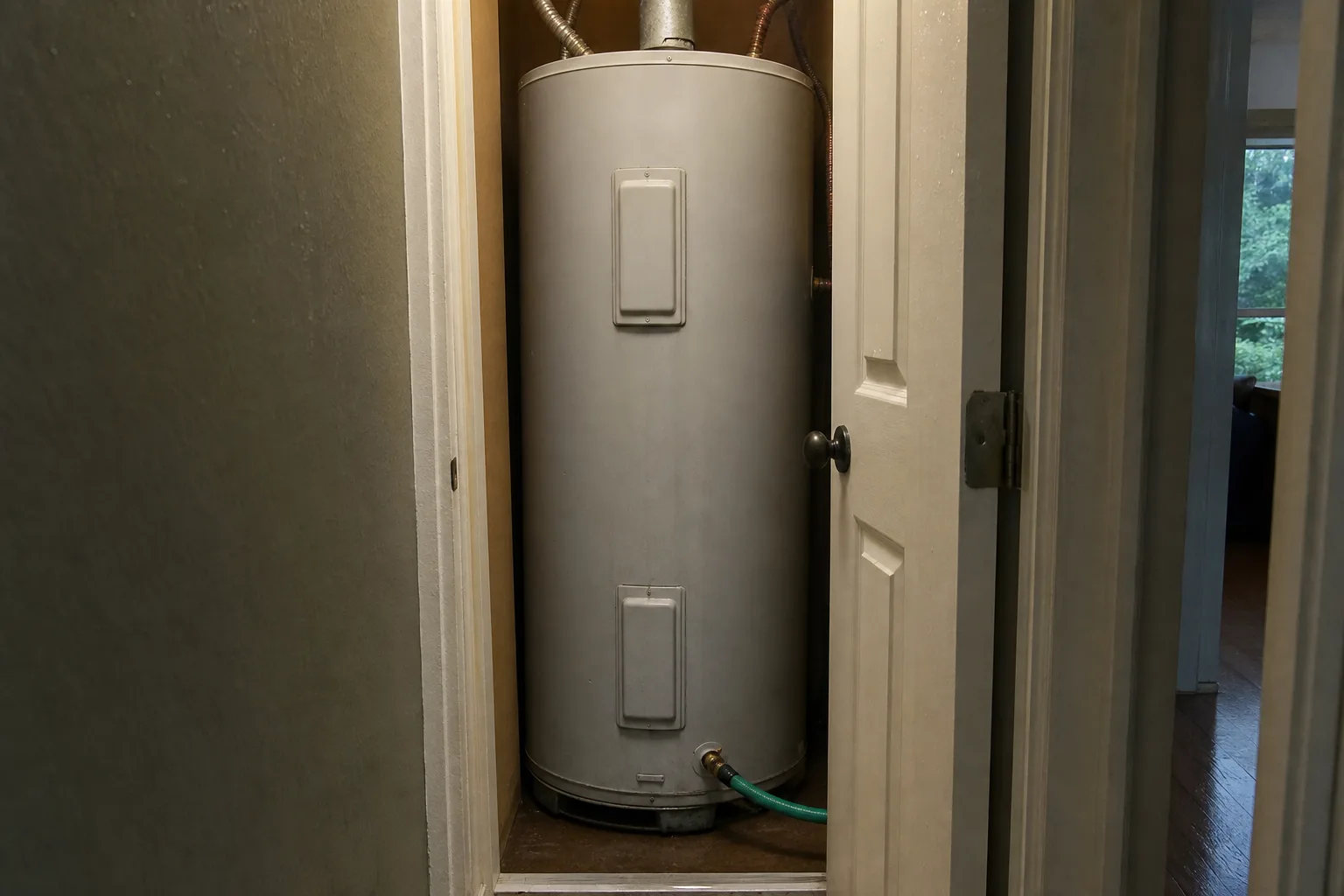
The house in question is a 1,400 square foot ranch outside Dayton, owned since 1997 by a man now in his eighties, and managed since 2021 by his daughter, who lives four hundred miles away and visits every six weeks. The failure that eventually cost her about eleven thousand dollars, between the tank, the subfloor, the vanity and two weeks of a dehumidifier running, did not begin with a broken part. It began with a hallway closet that was roughly twenty-six inches deep and fitted with a twenty-four inch door, holding a fifty gallon water heater installed the year the roof was done.
The clearance decided the maintenance, not the schedule
Flushing a tank requires a garden hose threaded onto a drain valve set a few inches above the floor, and it requires a hand and a wrist to get there. In that closet, the tank sat close enough to the left jamb that the valve pointed into the door frame, and a hose could be started but not tightened. Two plumbers over nine years wrote the same thing on their invoices in different words: access limited, recommend service at replacement. Nobody said the tank would not be flushed. Nobody said it plainly. The sediment accumulated on the schedule sediment keeps.
This is what a plan drawing hides. On paper the closet is labeled WH and shown as a square, and the square is large enough. What the square does not show is the swing of the door, the depth of the jamb, the width of an adult forearm, or the fact that a fitting needs about four inches of clear arc to turn. A few inches at the left edge of that closet determined nine years of upkeep, and no maintenance calendar, however diligent, was going to overcome them.
What changed recently, and why the replacement did not fit
When the tank finally let go, the daughter learned something that surprises most people replacing a water heater for the first time in a decade or more. Federal efficiency standards for residential water heaters, which the Department of Energy is responsible for setting, pushed manufacturers toward thicker insulation, and a tank of the same capacity is now commonly taller and wider than the one it replaces. A closet sized to a 2008 model can be short by an inch or two for a 2024 one. Her plumber measured before ordering, found the height clearance for the flue connection insufficient, and priced two options.
The first was a shorter, wider fifty gallon model that fit the height but left almost no side clearance, which would have reproduced the original problem exactly. The second was a lowboy tank set on a platform in the garage, with the closet converted to linen storage and the pipe run extended about eleven feet. She took the second, and it cost more, and it is the reason the next flush will take twenty minutes instead of never happening. The decision was not about the appliance. It was about whether a person could stand next to it.
Three cheap tools and one page of paper
The tools she now keeps in a bin by the garage door are unremarkable: a telescoping inspection mirror, a bright flashlight, a moisture meter of the kind sold for a modest sum at any hardware store, and a short length of hose already threaded and stored coiled. The paperwork matters more. She keeps a single sheet in a folder that lists the model and serial number of every appliance in the house, its install date, the location of its shutoff, and the date and scope of the last service performed on it. Scope is the operative word.
An invoice that reads service call and a price proves nothing later. An invoice that reads flushed tank until clear, tested temperature and pressure relief valve, inspected pan and drain line, photographed anode is a document a warranty administrator or an adjuster can read. She now asks for that language before the technician leaves, takes a photograph of the completed work with her phone, and drops it into a dated folder in cloud storage that her father's attorney and her brother can both open. It took her one afternoon to set up and about ten minutes per visit to maintain.
Where the compounding actually happened
The eleven thousand dollars was not the price of neglect. It was the price of nine years of a small physical obstruction that nobody named out loud, multiplied by a maintenance task that fails quietly and gives no warning until the floor is wet. Two inches at a door jamb, plus an invoice line that said recommend rather than cannot, was the whole of it. She has since walked the rest of the house with the mirror and the flashlight, looking for the same pattern: the crawlspace hatch behind the shelving, the cleanout blocked by a workbench, the filter slot a dryer now sits against.
Three of the four had a fix under a hundred dollars, and all four are on the sheet now, with dates.