Water in a House You Don't Live In? How the First Forty-Eight Hours Became Somebody Else's Checklist
The two-day drying window is now a documented procedure owned by large restoration networks and read by adjusters, and the room's dimensions decide most of it.
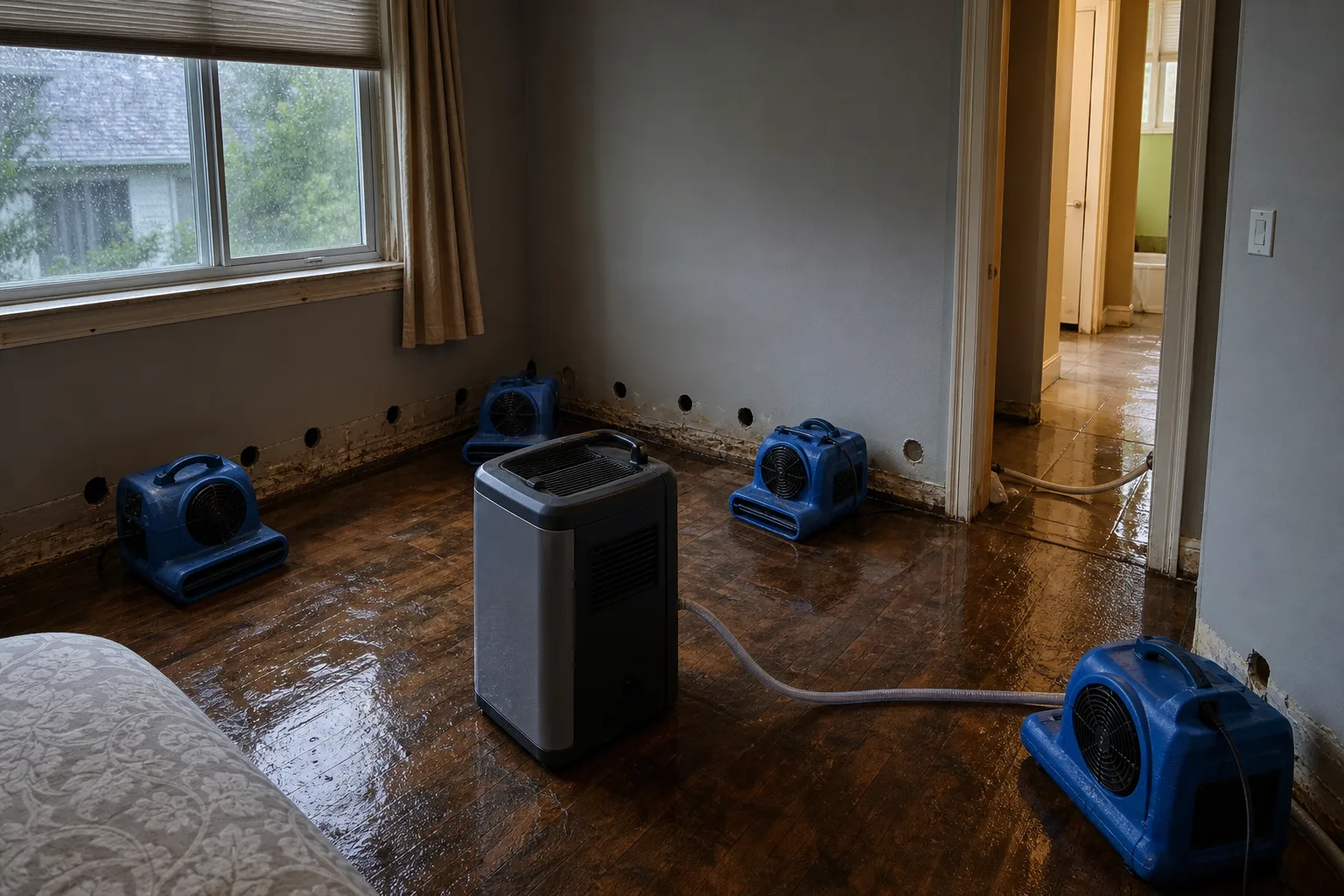
The two-day window after water gets into a building is not a rule of thumb somebody invented on a job site. It hardened into a procedure, with readings taken at fixed intervals, equipment counts derived from arithmetic, and a file that an insurance adjuster will read months later without ever visiting the house. If you are the one authorizing work on a property you do not occupy, a parent's house, a rental you own two states away, a building you manage for a family trust, the shape of that procedure matters more than the hourly rate, because it determines what gets recorded and therefore what gets paid.
How a rough guess turned into a documented interval
For a long time, drying a wet house was a matter of judgment. Someone opened windows, pulled up carpet, ran a fan, and came back in a week to see how it looked. What changed was the arrival of large restoration networks operating hundreds of locations under one set of procedures, and the parallel insistence from insurers that a claim arrive with evidence attached rather than a narrative. A national provider cannot rely on the instincts of one experienced technician in one town. It has to write the instinct down, teach it to crews in forty states, and make the output legible to a stranger reading a file.
That translation is why the first forty-eight hours now looks the way it does. The interval is not arbitrary, and it is not a marketing promise either; it reflects how quickly untreated moisture in a closed cavity stops being a drying problem and becomes a microbial one. The Environmental Protection Agency is the federal body responsible for guidance on indoor mold and moisture, and the practical consequence of that guidance filtering into commercial practice is that scope decisions get made early, in writing, while the situation is still reversible. Large providers built their intake around that reality because a slow start converts a cheap job into an expensive one.
The room's dimensions decide the equipment before anyone quotes a price
Here is the part most homeowners never see, and the part worth understanding if you are signing the authorization. The number of air movers a crew places is not a guess about how bad it looks. It comes from the room's linear wall footage and the affected floor area, one machine roughly every twelve to sixteen feet of wall, angled shallow against the surface rather than pointed at the puddle. The dehumidifier is sized from cubic volume, length by width by ceiling height, adjusted for how saturated the assembly is. A room with a nine-foot ceiling needs meaningfully more capacity than the same footprint at seven and a half.
This is why two houses with identical square footage of wet floor can generate very different equipment lists, and why a plan drawing tells you more about the bill than a photograph does. Interior partitions add wall length and add machines. An open-plan main floor with one long wet run may dry with less hardware than a warren of small bedrooms holding the same total area. Closets, kick spaces under cabinets, and the eight or nine inches behind a bathtub apron are where air will not reach on its own, and where a technician either drills, lifts, and vents, or leaves a pocket that stays wet for weeks.
What the daily readings are actually for
A crew that comes back each day with a meter is not performing diligence theater. They are building the record that justifies every hour of equipment rental on the eventual invoice, and, just as importantly, the record that establishes when drying is finished. Moisture is measured against an unaffected reference area in the same building, because wood and drywall in Phoenix sit at a different baseline than the same materials in Charleston. Without that comparison, nobody can say what dry means in this particular house. The daily log is what converts a judgment call into something an adjuster can approve without argument.
The scale of the larger providers is what made this consistent. When one company runs the same software, the same meters, and the same reporting template across a whole region, an adjuster learns to read the file quickly and to trust its structure. That predictability is worth real money to the person paying, because disputes over restoration bills usually come down to an absence of documentation rather than a disagreement about physics.
Signing for a house you will not sleep in
If the occupant is your mother, your tenant, or a sibling handling things badly, the authorization you sign creates obligations that someone else absorbs day to day. Agree in advance who lets crews in, who has authority to approve an expansion of scope when a technician finds wet subfloor under a doorway, and where the equipment noise and heat will be tolerable for three or four days. Ask for the moisture log to be sent to you, not left on a counter. Ask which materials are being removed and which are being dried in place, and get that written down before the second day ends, because that single distinction drives most of the cost and all of the reconstruction that follows.
Understanding the arithmetic behind the equipment count and the purpose of the daily readings puts you in a position to ask useful questions in the one window where the answers still change the outcome.