Who Actually Pays the Adjuster on a Large Loss, and What Each Fee Model Does to Your Risk
The adjuster standing in your flooded wing is paid by someone, under one of three arrangements, and that arrangement decides who absorbs an overrun.
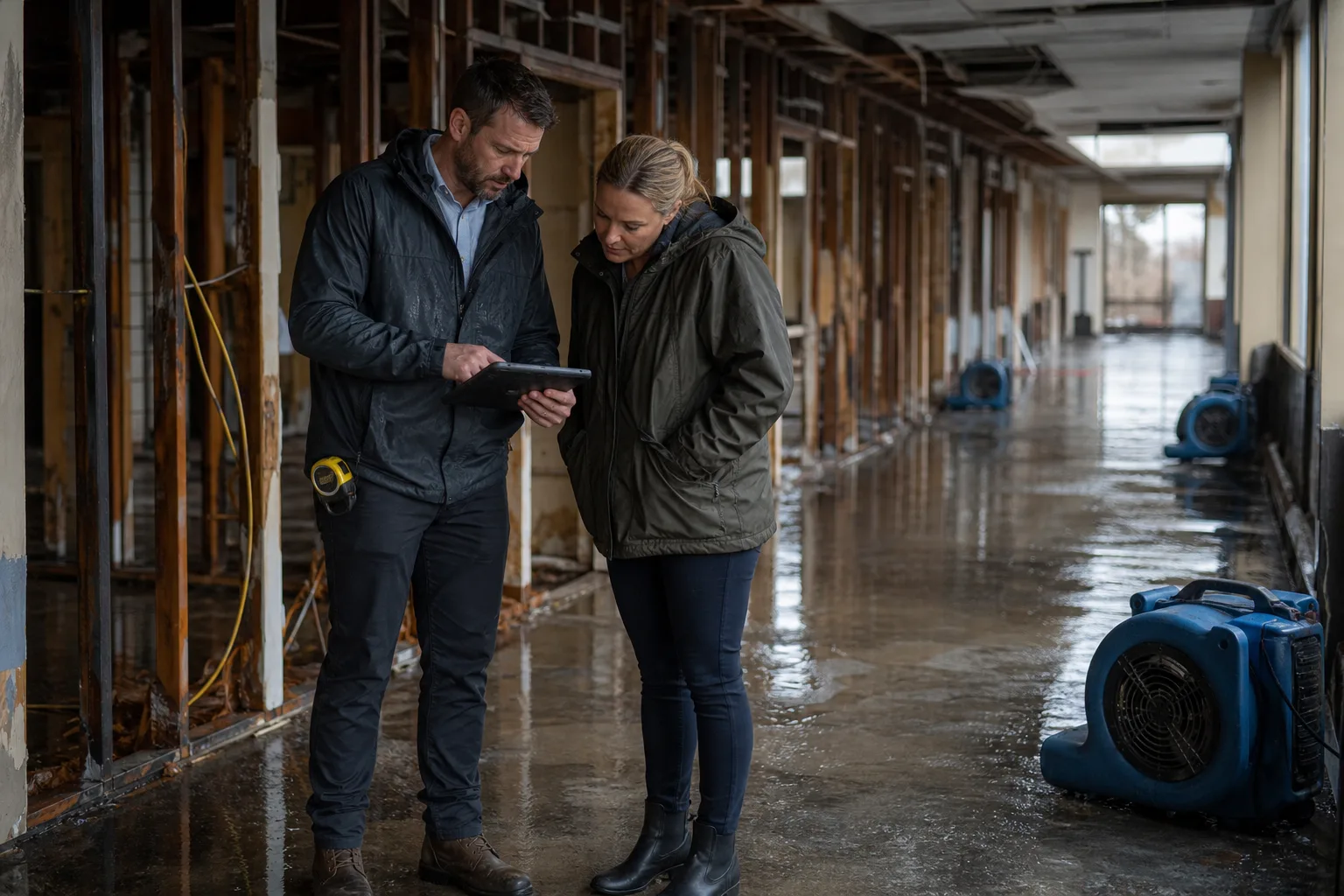
A property manager with four buildings and a burst riser on the third floor of one of them tends to assume the adjuster who shows up is a neutral referee, dispatched by the carrier to work out what is owed and write it down. That assumption is close enough to survive a small claim and expensive on a large one. The adjuster is a paid professional operating under a fee arrangement, and that arrangement shapes how much time gets spent on your file, how quickly a scope gets closed out, and who ends up holding the bill when the repair runs past the estimate. On a commercial loss with a board or an owner group behind it, the fee structure is worth understanding before the first walkthrough.
Three people are called the adjuster and only one of them works for you
The staff adjuster is an employee of the insurance carrier, salaried, carrying a caseload that is assigned rather than chosen. The independent adjuster is a contractor, engaged by the carrier through an adjusting firm, usually because the carrier's own staff cannot absorb the volume after a storm or because the loss needs a specialty skill. The public adjuster is the only one retained by the policyholder, and is the only one whose duty runs to the insured rather than the insurer. All three use the same estimating software and the same unit price lists. They do not have the same incentives, and on a claim involving a shared building system, a tenant business interruption, or an owner association's reserve, the difference shows up in the scope.
Contingency, flat fee, hourly: where the overrun actually lands
A public adjuster is almost always paid on contingency, a percentage of what the carrier pays, with the percentage set by state law in many jurisdictions and by contract everywhere else. That model puts the risk of a long, difficult claim on the adjuster: a file that takes nine months rather than nine weeks earns the same percentage. It also means the adjuster has no reason to take a claim that will settle easily anyway, which is why many decline small, clean losses. An independent adjusting firm, by contrast, is typically paid by the carrier either on a fee schedule tied to claim size or on an hourly basis, and a few operate on a straight day rate during catastrophe deployments. The fee schedule model puts overrun risk on the adjusting firm; the hourly model puts it on the carrier.
None of these fees come out of your settlement except the contingency. That distinction matters to a board treasurer reading a proposal, because a twenty percent public adjuster fee on a settlement is real money leaving the recovery, and it has to be weighed against what an unrepresented organization is likely to recover on its own. Ask for the fee basis in writing, ask whether it applies to the whole settlement or only to amounts above the carrier's first offer, and ask what happens to the fee if the claim is denied.
The restoration contractor is priced on a different model entirely
Running underneath the adjusting question is the question of how the work gets priced, and here the three familiar models appear in their clearest form. Most emergency mitigation on an insured loss is billed cost plus, against a published unit price database the carrier and the contractor both reference, with drying equipment charged by the unit per day. That arrangement puts overrun risk on whoever is paying, which is to say the carrier up to policy limits and the owner beyond them. A fixed price for the reconstruction phase moves that risk onto the contractor, who has priced the uncertainty into the number. A day rate sits in the middle and tends to favor the contractor, because time is the variable nobody can hold down once a wall is open.
A larger organization should expect to see all three on one loss, in sequence. Cost plus for the first week of water extraction and drying, because nobody can scope that in advance. Then a fixed price for the rebuild, once the damage is actually visible. The handoff between those two is the point where costs escape, and it is the point a board should ask about specifically.
What to settle before anyone starts
Decide who has authority to approve a change order and at what dollar threshold, because on a multi-building loss that decision is made a dozen times and rarely by the same person twice. Agree on how the adjuster's scope will be shared with your contractor and with you, in the native estimate file rather than a summary. Fix a reporting cadence so that the board hears about a scope increase in the week it happens. And note that flood claims run on separate rules: FEMA is responsible for the National Flood Insurance Program, and adjusters handling those losses work to its procedures rather than the carrier's ordinary practice.
An organization that knows which of its vendors is carrying the overrun risk, and has it written down before the drying equipment arrives, settles faster and argues less at the end.