Your Smart Alarm Maker Folded. The Lender Is Still a Party to the Deal
A household kept paying for a security system whose servers had gone dark, because the financing company was a separate party with its own clock and its own settlement math.
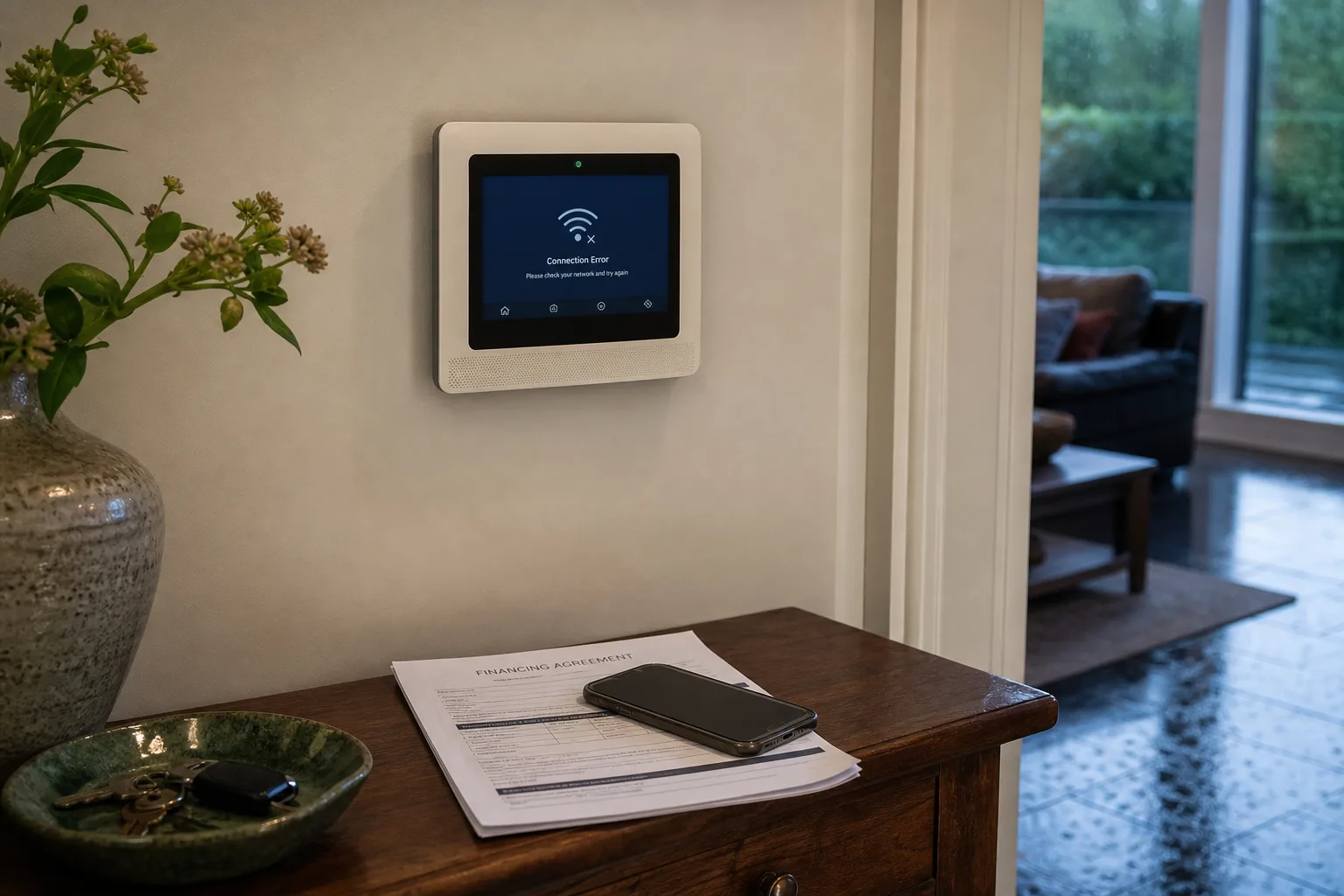
The system was sold as one purchase and it was actually three. A homeowner in a mid-sized suburb bought a connected alarm package in the spring: four door sensors, two cameras, a hub, and a keypad, installed in a single afternoon by a technician who worked for a regional dealer rather than the manufacturer. Monitoring was billed monthly. The hardware was financed over thirty-six months through a lender the homeowner met only as a logo on a tablet screen at the end of the install. Eleven months later the manufacturer's servers went dark, and the case of who owed what to whom began.
A system that worked until the servers stopped answering
Connected hardware is rarely self-sufficient. The sensors in this house talked to a hub, the hub talked to a cloud service, and the app on the homeowner's phone talked to that same cloud. Arming and disarming from the phone stopped first. Then the cameras kept recording locally but lost the retention window that the household had been paying for, and the monitoring center, which had been receiving alarm events through the manufacturer's back end, began missing them entirely. Nothing on the wall looked broken. Everything that made the wall equipment useful had moved off the property and then stopped existing.
The dealer's phone line went to voicemail for eight days, which is how most people first learn that the entity they bought from and the entity that keeps the product alive were never the same company. When someone finally called back, the message was that a receiver had been appointed over the manufacturer, that a successor firm might acquire the platform, and that customers should keep their equipment powered on. That was the whole of the guidance. Meanwhile, the automatic payment for the hardware cleared on the fifteenth of the month, exactly as it had every month since the install.
The party on the paperwork that nobody reads back
Here is the piece that gets missed. The homeowner believed she had one relationship, with the company whose name was on the keypad. She had three, and the one with the most durable claim against her was the lender. The retail installment contract she signed on the tablet had been assigned within days to a finance company that had paid the dealer up front and now owned the right to collect. That company did not sell her anything, did not install anything, and had no servers. It had a receivable, a payment schedule, and a reporting relationship with the credit bureaus. The Consumer Financial Protection Bureau oversees how consumer credit obligations of this kind are collected and reported, and the assignment of a contract is an ordinary, disclosed feature of that market rather than a surprise.
What surprised her was the practical asymmetry. The manufacturer was in a receivership where an unsecured customer claim would be worth cents, if anything, on a timeline measured in quarters. The dealer had thin assets and a lot of angry customers. The lender was solvent, reachable, regulated, and had a documented process for disputes involving goods that failed. It was also the only party whose decision would show up on a credit report. Most households spend their energy on the company that failed them. The company that can still act is usually the one holding the paper.
What the offer was worth once the months were counted
The lender's first written response, six weeks in, offered to suspend collection activity for ninety days while it investigated, and to waive the late fee that had accrued when she stopped the autopay in frustration. That was not a settlement. Its second response, after she sent the dealer's voicemail transcript, her monitoring invoices, and photographs of the app error screen, offered to reduce the outstanding balance by roughly the share attributable to the cloud-dependent components, close the account as paid, and report it as satisfied. She wanted more. The equipment had cost her the full price of a working system and she now had a keypad that beeped.
The arithmetic of pushing further looked like this. An attorney would want a retainer to evaluate claims against a receivership estate and a dealer of unknown solvency. Any recovery would arrive, if it arrived, long after the payment schedule ended. The lender's offer, by contrast, was available immediately, ended the monthly outflow, and removed the risk of a delinquency notation that would sit on her file for years and quietly reprice her next auto loan. The right question was never whether the offer was fair against what she had lost. It was whether any other route produced more money, sooner, with less exposure.
The consequences that trace back to a date, not a dollar figure
Settling in month three rather than month nine changed things that had nothing to do with the alarm. Her homeowners policy carried a credit for a monitored system, and the carrier's renewal questionnaire asked whether monitoring was active; answering honestly, with a resolved account and a replacement system already ordered, was a short conversation instead of a mid-term adjustment. The municipal alarm permit, which is renewed annually in her city and tied to a monitoring provider, could be updated in one filing rather than lapsing and requiring reapplication. She kept the sensors, which used a common wireless protocol and paired with a new hub from a different vendor, so the second system cost her the hub, the cameras, and an afternoon.
None of that appears in a settlement letter. It is the ordinary domestic residue of a dispute, and it compounds while the dispute stays open. The households that come out of a vendor collapse cleanly are usually the ones that identified early which counterparty was actually able to give them something, and then took the deliverable version of a resolution over the theoretical one.
Before signing anything for a connected product, read the last screen on the tablet and find out who ends up owning the debt, because that name, not the one on the box, is the one you will negotiate with if the platform goes away. It is worth two minutes at the point of sale and it is worth a great deal later.